

A truck crane for construction is no longer just a heavy lifting machine used occasionally on large projects. For many contractors, building material suppliers, steel structure installers, municipal engineering teams, and infrastructure companies, it has become a flexible jobsite solution that combines lifting, loading, transport, and fast relocation.
Construction sites today are often crowded, time-sensitive, and constantly changing. Materials arrive in batches, work zones shift throughout the day, and project teams need equipment that can move quickly without relying on too many separate machines. This is where a truck crane becomes valuable. It can lift steel components, unload building materials, support installation work, move tools and equipment, and then travel to the next job location.
However, choosing the right truck crane for construction requires more than looking at lifting capacity. Buyers need to consider working radius, boom length, chassis strength, outrigger stability, jobsite access, load charts, operator visibility, hydraulic performance, and safety requirements. A crane that looks powerful on paper may not be the best fit if it cannot work efficiently in the real site environment.
This guide explains how to select a truck crane for construction from a practical, project-based perspective.
Table of Contents
Why Construction Projects Need Truck Cranes

Construction work involves constant material movement. Steel beams, pipes, panels, tools, prefabricated parts, formwork, machinery, and building supplies often need to be unloaded, lifted, positioned, or transferred across the site.
A truck crane helps construction teams solve several common problems:
- Materials need to be unloaded directly from the truck.
- The lifting location changes frequently.
- The jobsite has limited space for large lifting equipment.
- Materials must be moved between different work areas.
- The project requires both transport and lifting.
- Contractors need faster deployment for short lifting tasks.
Unlike equipment that stays in one location, a truck crane can move with the construction schedule. This makes it especially useful for projects where lifting tasks are repeated but not always in the same place.
For buyers comparing different lifting options, the truck crane product category provides a practical starting point for reviewing available truck crane configurations.
What Makes a Truck Crane Different From Other Construction Lifting Equipment?
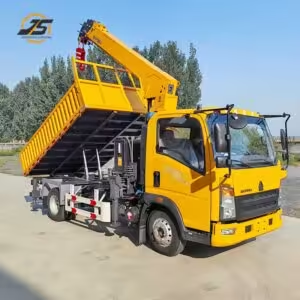
A truck crane combines a crane system with a truck chassis. This structure gives it two major advantages: mobility and transport capability.
On many construction sites, lifting equipment is not only expected to lift. It also needs to arrive quickly, carry materials, access different work zones, and support multiple tasks during the same day. A truck crane can often reduce the need for separate transport vehicles and loading equipment.
Compared with some stationary or site-restricted lifting solutions, a truck crane is easier to relocate. Compared with basic material handling equipment, it can lift higher and place loads more precisely. Compared with larger lifting machines, it may be more practical for medium-duty construction tasks that require flexibility rather than extreme capacity.
The best applications usually include:
- Building material delivery
- Steel structure installation support
- Prefabricated component handling
- Road and bridge maintenance
- Utility construction
- Rural construction projects
- Urban repair work
- Small and medium construction sites
- Equipment loading and unloading
For projects involving narrow indoor spaces, upper floors, or restricted access, buyers may also compare compact equipment such as a spider crane. For work that requires folding boom movement around obstacles, a knuckle boom crane may also be worth evaluating.
Main Construction Applications of Truck Cranes
A truck crane for construction can support many jobsite tasks. The exact use depends on crane capacity, boom reach, site access, and load type.
Lifting Steel and Structural Components
Steel beams, columns, trusses, and connection parts often require controlled lifting. A truck crane can help position these components during unloading, staging, and installation support.
Handling Precast and Prefabricated Materials
Prefabricated panels, concrete components, modular elements, and assembled construction parts require stable lifting and careful placement. A truck crane can help contractors reduce manual handling and improve jobsite flow.
Loading and Unloading Building Materials
Construction sites receive many deliveries, including pipes, boards, frames, equipment, and packaged materials. A truck crane can unload cargo directly from the truck bed and place it closer to the working area.
Supporting Road and Municipal Construction
Road barriers, lighting poles, drainage parts, small machines, and repair materials are common municipal construction loads. A truck crane is useful because it can move between multiple work points in the same day.
Equipment Installation and Maintenance
Construction projects often require lifting generators, compressors, pumps, tools, and small machines. A truck crane helps position these loads without waiting for separate lifting equipment.
Working Across Multiple Sites
Contractors handling several projects benefit from a crane that can travel independently. This is one of the biggest advantages of using a truck crane for construction.
How to Choose the Right Capacity

Capacity is important, but it should never be evaluated alone. The maximum lifting capacity usually applies under specific working conditions, often at a shorter radius. As the boom extends farther from the truck, the actual lifting capacity decreases.
A practical buyer should define three numbers before selecting a crane:
| Selection Factor | Why It Matters |
|---|---|
| Typical load weight | Helps avoid oversizing or undersizing |
| Maximum load weight | Determines required safety margin |
| Required working radius | Shows whether the crane can lift the load at real distance |
For example, a crane may be able to lift a heavy load close to the truck but may not lift the same load when the boom is fully extended. This is why load charts are essential.
When evaluating a truck crane, buyers should ask:
- What is the heaviest material the crane will lift?
- How far from the truck will the material be placed?
- Will the lift happen from the side, rear, or another angle?
- How high does the crane need to lift?
- How often will lifting happen each day?
- Will the crane lift compact loads or long, irregular materials?
The right truck crane for construction is not always the biggest one. It is the crane that can safely complete the most common lifting tasks with reliable performance.
Boom Reach and Working Radius Matter More Than Many Buyers Expect
Boom reach determines how far and how high the crane can place materials. In construction, this can be just as important as lifting capacity.
A jobsite may require the crane to place materials over barriers, across a narrow area, onto a platform, or near an installation position. If the boom reach is too short, the crane may need frequent repositioning. If the working radius exceeds the crane’s safe capacity range, lifting may become unsafe.
Buyers should evaluate:
- Maximum boom length
- Maximum lifting height
- Capacity at common working radius
- Boom angle range
- Rotation coverage
- Side lifting capability
- Rear lifting capability
- Stability when outriggers are deployed
The OSHA cranes and derricks in construction guidance emphasizes the importance of crane safety hazards in construction environments, which is why working radius, rated capacity, and site conditions should be considered before lifting.
A good rule for buyers is simple: do not choose based only on maximum capacity. Choose based on the load chart and the real working radius.
Chassis Selection for Construction Sites
A truck crane is only as reliable as the chassis supporting it. Construction work often involves uneven access roads, temporary ground surfaces, heavy cargo, and frequent movement. The chassis must be strong enough for both road travel and jobsite operation.
Important chassis factors include:
- Wheelbase
- Engine power
- Braking performance
- Tire specification
- Frame strength
- Cargo bed size
- Turning radius
- Road condition adaptability
- Payload capacity
- Maintenance accessibility
For urban construction, maneuverability may be more important because the crane needs to work in limited spaces. For rural or infrastructure projects, traction and frame durability may be more important. For material suppliers, cargo bed size and loading efficiency may influence the final decision.
Buyers should match the chassis to actual job conditions. A chassis that is too light may reduce stability and durability. A chassis that is too large may create access problems on compact construction sites.
The full product page can help buyers compare different lifting equipment categories and choose a more suitable configuration.
Outriggers and Ground Conditions Are Critical
Outriggers help stabilize the truck crane during lifting. On construction sites, ground conditions can change quickly. Soft soil, unfinished pavement, slopes, underground voids, loose gravel, and temporary road surfaces can all affect crane stability.
Before lifting, the operator should confirm that the ground can support the crane, load, and outrigger pressure. This is especially important when lifting heavy materials or working at longer radius.
Buyers should pay attention to:
- Outrigger span
- Outrigger control method
- Ground contact area
- Stability during side lifting
- Ease of setup
- Hydraulic reliability
- Support requirements for uneven ground
A construction truck crane should be evaluated as a complete stability system: crane, chassis, outriggers, ground, load, and operator control all work together.
The OSHA crane standards page provides safety references for cranes, derricks, and hoists across different working environments. Buyers can use such references to better understand why proper setup and inspection matter before each lift.
Straight Boom or Knuckle Boom for Construction?
Both straight boom and knuckle boom cranes can be used in construction, but they are suited to different lifting needs.
A straight boom truck crane is commonly used when the project needs vertical lifting height, direct placement, and simple operation. It is useful for lifting steel, building materials, equipment, and construction components.
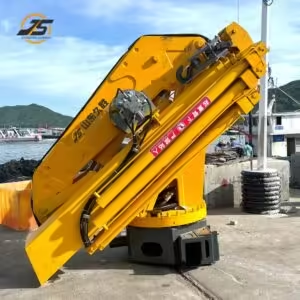
A knuckle boom crane is helpful when the jobsite has obstacles, limited storage space, or requires more flexible load positioning. Its folding structure can make it easier to place materials in complex areas.
| Feature | Straight Boom Truck Crane | Knuckle Boom Crane |
| Best advantage | Height and direct lifting | Flexible movement around obstacles |
| Common construction use | Steel, materials, equipment | Urban sites, delivery, precise placement |
| Boom style | Telescopic or straight extension | Folding articulated structure |
| Storage | Longer boom profile | Compact folded structure |
| Operation focus | Lifting height and reach | Flexible positioning |
For many construction buyers, the best choice depends on whether the work mainly requires lifting height or flexible placement. If the project includes both, the supplier should evaluate the actual site conditions before recommending a model.

Hydraulic System Performance for Construction Work
A construction truck crane often performs repeated lifting tasks. This makes hydraulic performance very important.
A good hydraulic system supports smoother lifting, stable boom extension, controlled slewing, and reliable outrigger movement. Poor hydraulic response can reduce efficiency and make precise placement difficult.
Buyers should review:
- Hydraulic pressure
- System flow
- Oil tank capacity
- Heat management
- Boom movement smoothness
- Control sensitivity
- Sealing quality
- Maintenance convenience
- Component accessibility
For construction work, smooth control can be more valuable than raw speed. When lifting steel, panels, equipment, or irregular loads, controlled movement helps improve placement accuracy and reduce unnecessary load swing.
The article How Does a Truck Crane Work? can be used as a related internal resource for readers who want to understand the basic operating principle of a truck crane.
Safety Factors Construction Buyers Should Check
A truck crane for construction should be selected with safety in mind from the beginning. Safety is not only about operator behavior. It also depends on equipment configuration, jobsite planning, inspection habits, and load control.
Important safety factors include:
- Load chart availability
- Rated capacity at working radius
- Outrigger setup procedure
- Ground condition assessment
- Operator training
- Signal communication
- Daily inspection
- Hydraulic system inspection
- Boom and hook inspection
- Wind and weather limits
- Work zone control
- Power line awareness
The ASME B30.5 mobile and locomotive cranes standard is widely recognized in the construction industry and addresses mobile crane safety topics. Buyers do not need to become standards experts, but they should understand that crane selection and use must follow a safety-first approach.
If the crane will be used in markets with specific safety rules, buyers should confirm local requirements before purchase.
Load Chart Understanding for Construction Buyers
A load chart tells the operator how much the crane can lift under specific conditions. It is one of the most important documents for safe crane operation.
A construction buyer should understand that capacity changes based on:
- Boom length
- Boom angle
- Working radius
- Lifting direction
- Outrigger position
- Ground condition
- Crane configuration
- Load weight and load shape
For example, lifting a load close to the truck is not the same as lifting the same load at a longer horizontal distance. A crane may safely handle a material near the truck but require a different setup when placing the material farther away.
A good supplier should help buyers understand how load charts apply to their real work. This is especially important for buyers who are selecting their first construction truck crane.
Common Mistakes When Buying a Truck Crane for Construction
Many buyers focus too much on basic specifications and overlook real jobsite needs. This can lead to low efficiency, unsafe operation, or unnecessary equipment limitations.
Common mistakes include:
Choosing Only by Maximum Capacity
Maximum capacity does not represent all working conditions. Buyers must check capacity at actual radius.
Ignoring Site Access
A crane that is too large may struggle to enter compact construction areas or urban streets.
Underestimating Ground Conditions
Even a good crane can be unsafe if the ground cannot support the load.
Forgetting Cargo Requirements
A truck crane must often carry materials as well as lift them. Cargo bed size matters.
Not Reviewing Maintenance Support
Construction equipment needs regular inspection and service. Maintenance planning affects long-term reliability.
Overlooking Operator Training
A skilled operator improves safety, efficiency, and equipment life.
Avoiding these mistakes helps buyers choose a truck crane that performs well in daily construction work.
Truck Crane Selection Checklist for Construction Buyers
Before contacting a supplier, buyers should prepare a clear project profile.
| Question | Buyer’s Notes |
| What materials will be lifted? | Steel, pipes, panels, machines, tools, etc. |
| What is the typical load weight? | Helps match common working needs |
| What is the maximum load weight? | Helps define capacity range |
| What lifting height is required? | Important for building and installation |
| What working radius is needed? | Critical for load chart matching |
| What road conditions will the truck face? | Affects chassis selection |
| Is the site narrow or open? | Affects crane size and maneuverability |
| Will the crane transport materials? | Affects cargo bed and payload needs |
| How often will lifting happen? | Affects hydraulic and durability needs |
| Is customization required? | Helps match special working scenarios |
When buyers have this information ready, model selection becomes faster and more accurate. For customized requirements, project details can be submitted through the contact page.
Maintenance Planning for Construction Truck Cranes
Construction sites can be tough on equipment. Dust, uneven ground, repeated lifting, weather exposure, and heavy loads all increase maintenance demands.
A good maintenance plan should include:
- Daily visual inspection
- Hydraulic oil level checks
- Hose and fitting inspection
- Boom structure inspection
- Outrigger testing
- Hook and wire rope inspection
- Slewing system inspection
- Fastener checks
- Lubrication
- Tire and brake inspection
- Chassis service
- Control system testing
Maintenance should be planned before problems appear. A well-maintained truck crane can reduce downtime, improve safety, and extend service life.
Buyers can also use the news section as a place to build supporting content such as crane operation tips, maintenance guides, and construction lifting knowledge.
When a Truck Crane Is the Right Choice for Construction

A truck crane is a strong choice when the project needs mobility, lifting flexibility, and material transport. It is especially suitable when lifting jobs are spread across multiple areas or when contractors need one machine to support several tasks.
A truck crane may be the right choice if:
- The project requires frequent material unloading.
- The crane needs to move between sites.
- Loads are medium-duty and varied.
- The jobsite needs flexible lifting support.
- Transport and lifting must be combined.
- Setup speed matters.
- The project has limited space for multiple machines.
It may not be the best choice if the project requires extremely high lifting capacity at very long radius or continuous heavy lifting in one fixed location. In those cases, buyers should compare other lifting equipment types.
Conclusion
A truck crane for construction can improve jobsite efficiency by combining lifting, loading, transport, and mobility in one machine. For contractors and project buyers, the right truck crane can reduce equipment coordination, speed up material handling, and support a wide range of construction tasks.
The best selection is not based only on maximum lifting capacity. Buyers should evaluate working radius, boom reach, chassis strength, outriggers, ground conditions, hydraulic performance, load charts, maintenance needs, and safety requirements.
For construction projects that require a reliable and flexible lifting solution, a properly selected truck crane can become a practical long-term investment in productivity and site efficiency.
To compare suitable models, visit the truck crane product category. For project-specific lifting needs, chassis requirements, or customized configurations, send your working conditions through the contact page.
 English
  Russian
  French
  Spanish
  Arabic