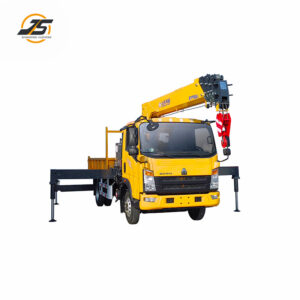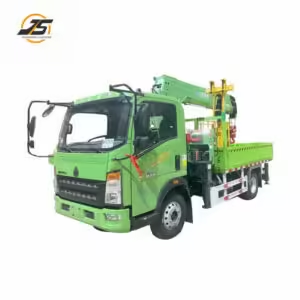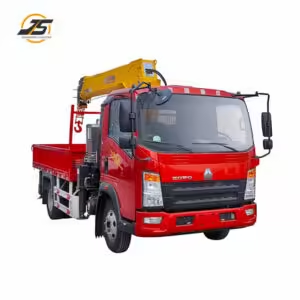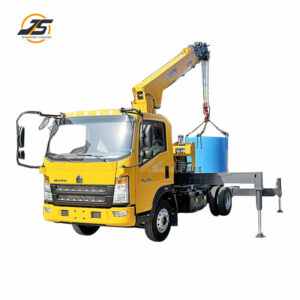
Quality Assurance
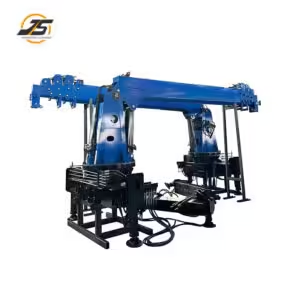
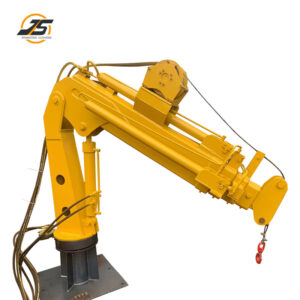
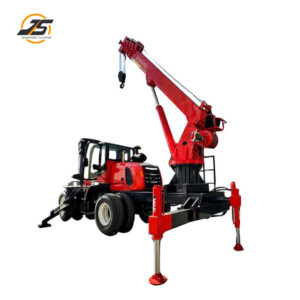
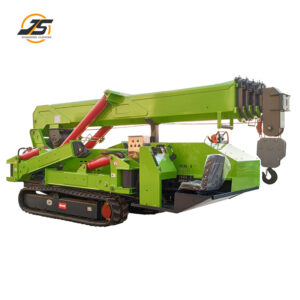
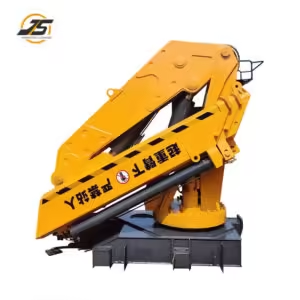
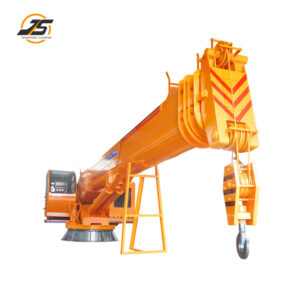
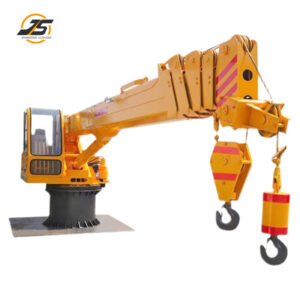
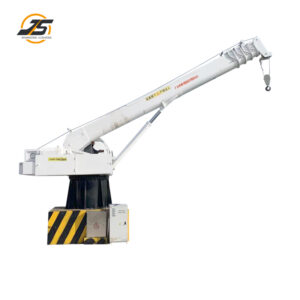
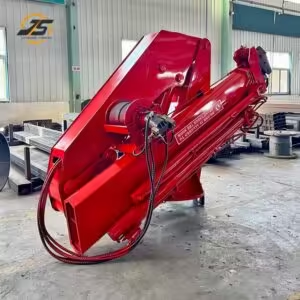
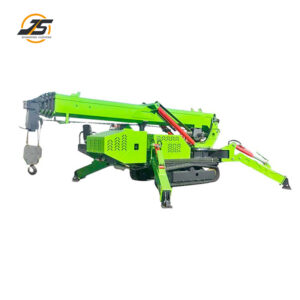
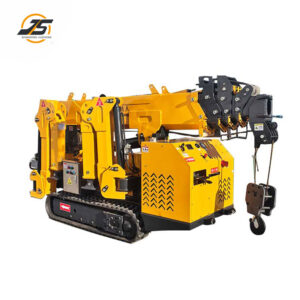
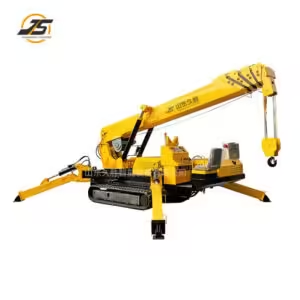
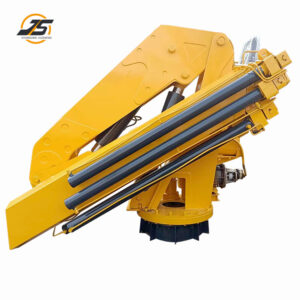
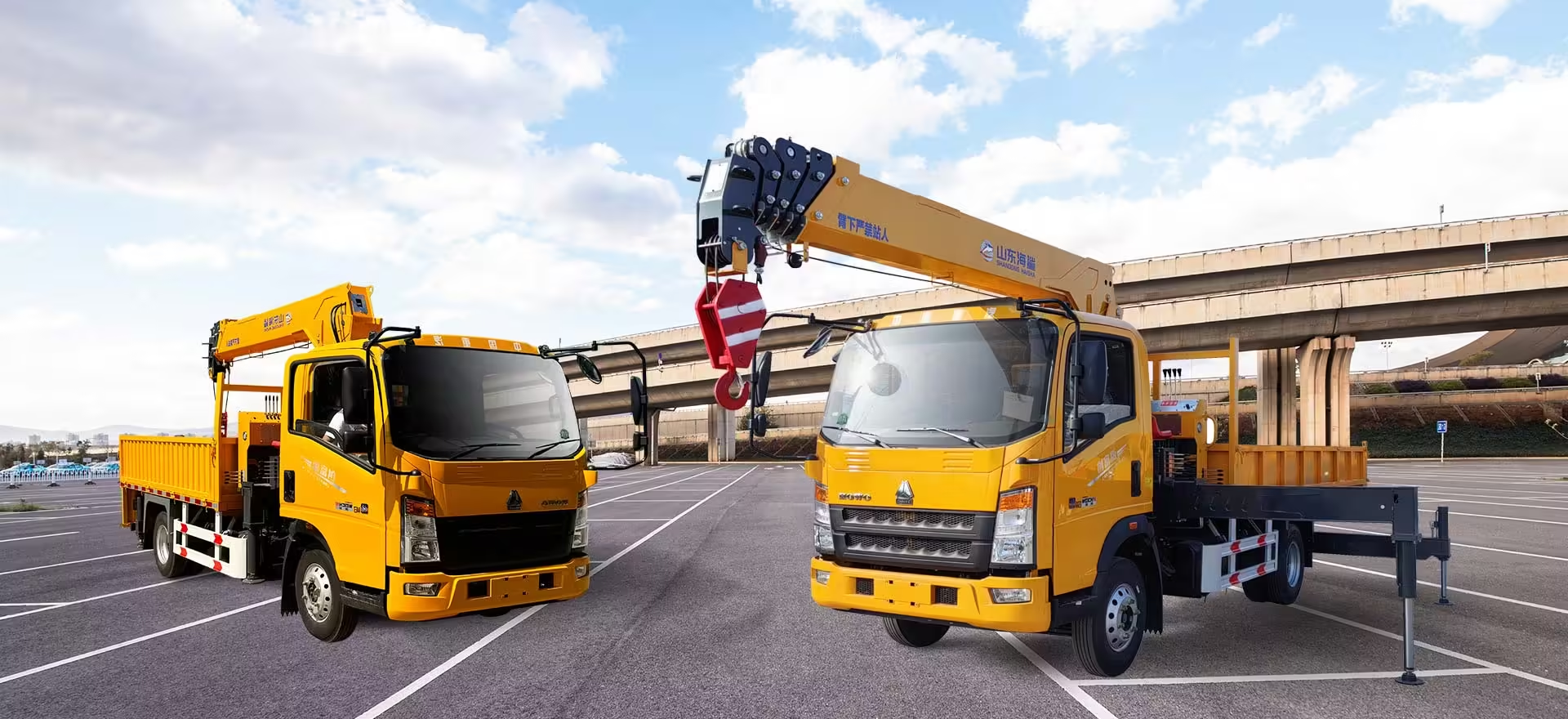
The crane is made of excellent materials, scientifically designed, finely crafted and of reliable quality.
Support customization
Provide global customized logistics solutions to ensure on-time delivery of lifting equipment.
Logistics and distribution
We offer customized logistics solutions worldwide to ensure that your crane equipment reaches its destination on time.
After-sales guarantee
We can provide videos and on-site installation guidance, and all mechanical products enjoy a one-year warranty.
Why Choose Us
Shandong Jiusheng Intelligent Equipment Co.,Ltd.
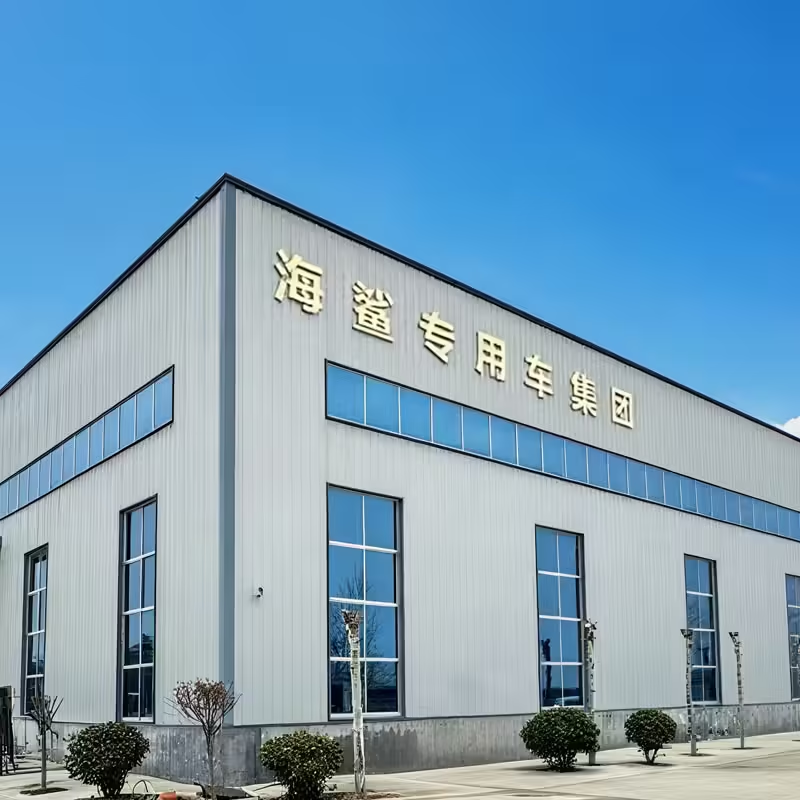
Located in the Economic Development Zone of Jining,Shandong Province,Shandong Jiusheng Intelligent Equipment Co.,Ltd.covers an area of 10,000 m²and is a high-tech enterprise integrating R&D,production,and sales. In 2023, the company established its subsidiary — Shandong Haisha Special Vehicle (Group) Co., Ltd., specializing in the R&D, production, and sales of special equipment including truck-mounted cranes and aerial work platforms.
We focus on the research, development, production and sales of various special-shaped cranes and small dump trucks, which are suitable for urban and rural construction, ports and other scenarios. They have advanced technology, convenient operation, safety and reliability, and excellent performance.
Shandong Jiusheng sincerely looks forward to collaborating with new and existing partners to build a brighter future together!
0
Strategic Partners
0
Project Cases
0
Sales Area
0
After-sales service
Let’s choose
Choose your Preferred Category
-
16T Boom
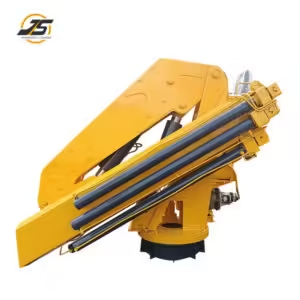
The boom is the core component of lifting equipment (such as truck cranes, crawler cranes, marine cranes, knuckle boom cranes, etc.), enabling cargo lifting and positioning through telescoping, slewing, or folding. Its design directly affects the crane’s lifting capacity, working radius, and applicable scenarios. Basic Components: Main Boom: The foundational support structure, typically designed as a box-type or truss configuration, providing the primary load-bearing capacity. Jib (Optional): Attached to the top of the main boom to extend the working radius or increase lifting height, suitable for specialized operations (e.g., high-rise building construction). Telescoping Mechanism: Adjusts boom length via hydraulic or mechanical transmission, with some booms supporting multi-stage synchronous extension. Connection Joints: Utilize high-strength bolts or pin connections to ensure structural stability. -
3.2 T Knuckle Boom Crane
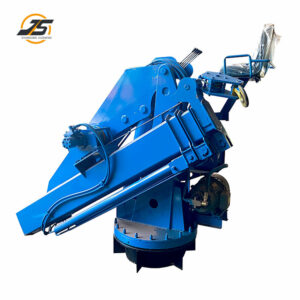
The knuckle boom crane is a kind of lifting equipment, which has the characteristics of flexibility, efficiency, safety and reliability, and can be installed behind the cab of the automobile chassis, which can realize 360° full-range hoisting operations, with large lifting torque and small working space. -
T50 Rough Terrain Forklift Tail Crane
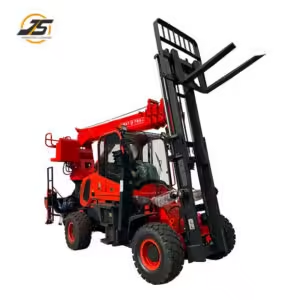
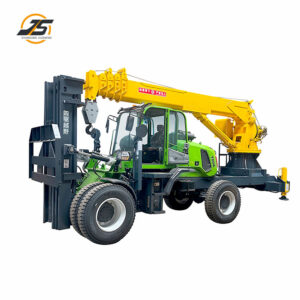
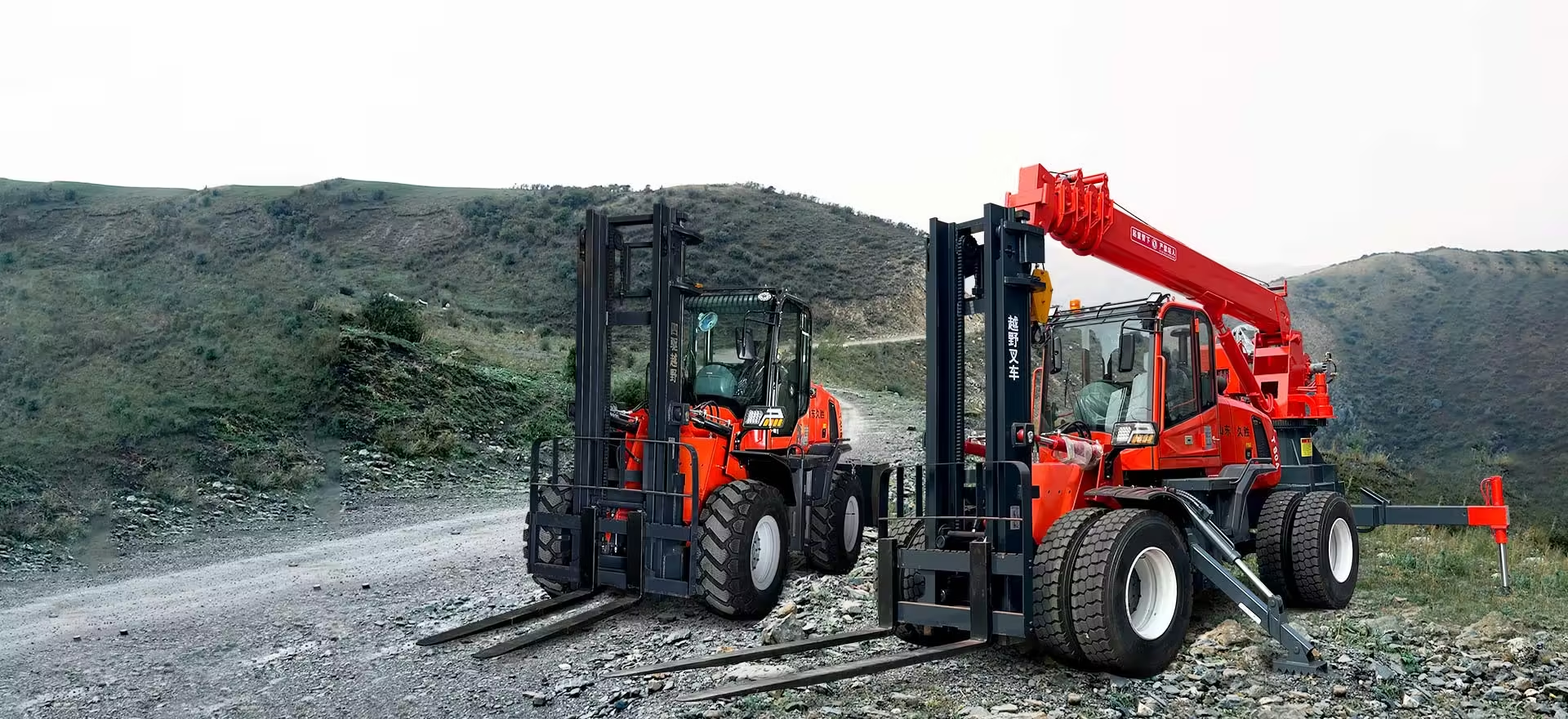
Rough Terrain Forklift Tail Crane A rough terrain forklift tail crane is a specialized lifting device that integrates a boom attachment onto a forklift. Below is a detailed introduction to its structural features, working principles, and applications. 1. Structural Features Boom Design: The crane boom is typically telescopic and straight-arm, allowing adjustment for various lifting needs. The boom can swivel at different angles, enabling low-level and high-level material handling. Mounting System: The crane is usually connected to the forklift forks via a sleeve mechanism, utilizing the forklift’s existing hydraulic system with quick-release couplings for easy installation and removal. Space Efficiency: The boom can be folded downward when not in use, minimizing space occupation and allowing the forklift to maneuver, turn, and operate even in tight spaces. 2. Working Principle Hydraulic Drive: The crane operates via a hydraulic transmission system, where the forklift’s hydraulic pump supplies power. Control valves regulate oil flow to drive hydraulic cylinders, enabling boom extension, retraction, lifting, and lowering. Ease of Operation: The rough terrain forklift tail crane is user-friendly, safe, reliable, and highly mobile, offering high efficiency and versatility. 3. Applications Confined Space Operations: Due to its compact size and agility, the rough terrain forklift tail crane is ideal for lifting tasks in narrow spaces inaccessible to traditional cranes, such as alleys, low-ceiling workshops, basements, and multi-floor buildings. Aerial Work: With the boom extended and the forklift’s mast raised, it can reach considerable heights (e.g., 13 meters), making it suitable for streetlight installation, billboard mounting, and AC unit placement. Warehousing & Logistics: The crane can handle bulk bag unloading, doorway installations, and other material-handling tasks. Landscaping: It efficiently transports saplings and trees for landscaping projects. Roadside Rescue & Construction: The forklift crane is also used in emergency recovery and small-scale construction sites. -
10 Ton Spider Crane
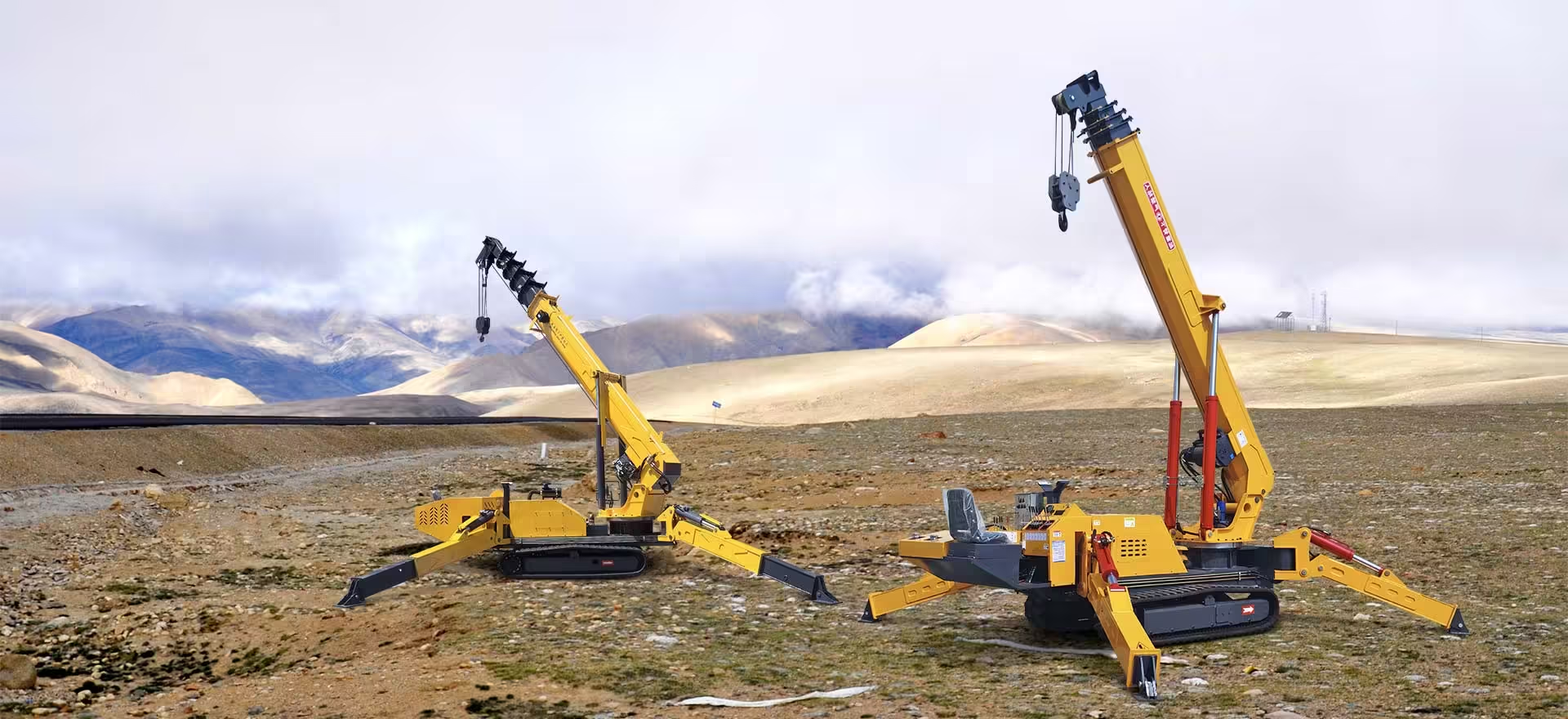
Spider Crane A spider crane is a small-to-medium-sized lifting device designed to mimic the shape and functionality of a spider, named for its four extendable outriggers that resemble spider legs when deployed. It achieves rotation and extension movements through these four retractable support legs and a central turntable, simulating the locomotion of a spider. Once its gripper secures an object, the crane lifts the load via steel cables and transports it to the designated location, accomplishing complex lifting tasks with precision. Key Features Compact Design: Small footprint and lightweight, ideal for confined spaces. High Flexibility & Efficiency: 360-degree full rotation, adaptable to varying heights and working radii. User-Friendly Operation: Wireless remote control minimizes the need for hazardous aerial work. Diverse Power Options: Hybrid (fuel/electric) or fully electric models to suit different environments. Applications Construction: High-rise building lifts, steel structure installation, concrete mixing and transport. Urban & Municipal Projects: Road repairs, bridge maintenance, public facility installation. Power & Energy Sector: Cable laying, wind turbine assembly, substation equipment maintenance. Petrochemical Industry: Equipment installation/repair, oil well servicing, pipeline installation. Transport Infrastructure: Subway tunnels, bridges, railways, and culvert construction/repair. Emergency Response: Disaster relief material handling, urgent equipment repairs. Let me know if you’d like any refinements! -
8T Boom
The boom is the core component of lifting equipment (such as truck cranes, crawler cranes, marine cranes, knuckle boom cranes, etc.), enabling cargo lifting and positioning through telescoping, slewing, or folding. Its design directly affects the crane’s lifting capacity, working radius, and applicable scenarios. Basic Components: Main Boom: The foundational support structure, typically designed as a box-type or truss configuration, providing the primary load-bearing capacity. Jib (Optional): Attached to the top of the main boom to extend the working radius or increase lifting height, suitable for specialized operations (e.g., high-rise building construction). Telescoping Mechanism: Adjusts boom length via hydraulic or mechanical transmission, with some booms supporting multi-stage synchronous extension. Connection Joints: Utilize high-strength bolts or pin connections to ensure structural stability. -
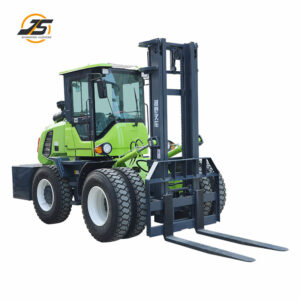
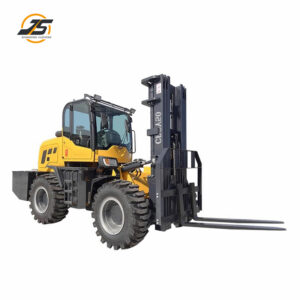
10 Tons Off-Road Forklift
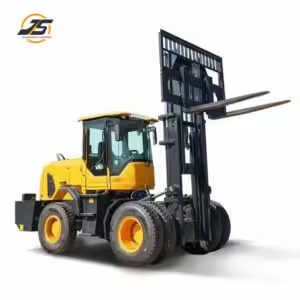
Off-road forklifts, also known as field forklifts, are material-handling equipment designed for loading and unloading goods in areas with poor road conditions, such as airports, docks, and railway stations. They feature excellent mobility, off-road capability, and reliability. An off-road forklift typically consists of four main components: Engine Chassis Working mechanism Electrical system These forklifts are primarily used in: Urban construction sites Pipeline installation Oilfield development Mountainous and forested areas for field engineering Container handling at ports and freight yards Military logistics for transporting supplies during wartime Let me know if you’d like any adjustments! -
6 Tons Off-Road Forklift
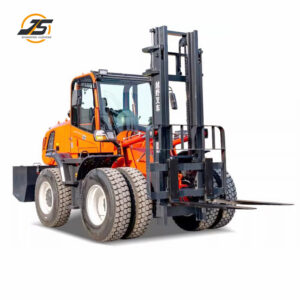
Off-road forklifts are industrial vehicles specifically designed for complex terrains and harsh working conditions, featuring robust off-road capabilities and adaptability to multiple scenarios. They are widely used in construction, mining, agriculture, forestry, and logistics. I. Core Features Off-Road Performance: Equipped with four-wheel drive or full-time all-wheel-drive systems, paired with large-diameter, deep-tread tires to enhance traction on muddy, sandy, and rocky surfaces. Power System: Primarily powered by diesel engines, delivering high torque and extended endurance, making them ideal for heavy-load continuous operations. Reinforced Structure: The chassis is constructed with high-strength steel, improving torsional rigidity by over 30% to withstand rugged terrains. II. Core Application Scenarios Construction & Infrastructure: In construction waste yards or earthwork sites, off-road forklifts can quickly load debris, bricks, and other waste materials, adapting to muddy or uneven ground. Mining & Quarries: With a load capacity of 8–10 tons, they can transport ores and blasting equipment to open-pit mines, featuring a climbing ability of 35%–45% to meet steep slope operations in mining areas. Agricultural Transport: In orchards and farms, they move fruit crates and feed bags, while the tire tread design reduces soil compaction (pressure decreased by 20%–30%), protecting farmland structure. Forestry Operations: Equipped with log grapple attachments, they can load logs and branches onto transport vehicles, adapting to narrow mountain slopes. Let me know if you’d like any refinements! -
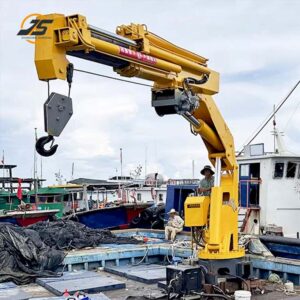
8T Marine Cranes
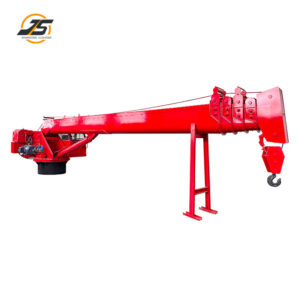
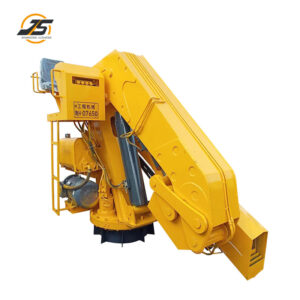
Marine cranes are lifting equipment installed on ship decks, primarily used for cargo handling, equipment installation, and underwater operations. Their design must adapt to marine environments, offering high flexibility and multifunctionality. I. Core Components: Boom: Telescopic or foldable to enable cargo lifting at various radii. Slewing Mechanism: Supports 360-degree rotation, enhancing operational flexibility. Hoisting Mechanism: Includes winches, wire ropes, and hooks for lifting and lowering cargo. Power System: Typically driven by the ship’s built-in motor or hydraulic system. II. Advantages: High Flexibility: 360-degree rotation and adjustable boom adapt to complex working conditions. Multifunctionality: Integrates lifting, transporting, and positioning functions, reducing equipment switching costs. Environmental Adaptability: Features anti-corrosion materials and sealed designs for stable operation in harsh sea conditions. Marine cranes are essential for port cargo handling, particularly suited for bulk goods, containers, and heavy equipment lifting.
Show Next
-
12 Ton Spider Crane
Spider Crane A spider crane is a small-to-medium-sized lifting device designed to mimic the shape and functionality of a spider, named for its four extendable outriggers that resemble spider legs when deployed. It achieves rotation and extension movements through these four retractable support legs and a central turntable, simulating the locomotion of a spider. Once its gripper secures an object, the crane lifts the load via steel cables and transports it to the designated location, accomplishing complex lifting tasks with precision. Key Features Compact Design: Small footprint and lightweight, ideal for confined spaces. High Flexibility & Efficiency: 360-degree full rotation, adaptable to varying heights and working radii. User-Friendly Operation: Wireless remote control minimizes the need for hazardous aerial work. Diverse Power Options: Hybrid (fuel/electric) or fully electric models to suit different environments. Applications Construction: High-rise building lifts, steel structure installation, concrete mixing and transport. Urban & Municipal Projects: Road repairs, bridge maintenance, public facility installation. Power & Energy Sector: Cable laying, wind turbine assembly, substation equipment maintenance. Petrochemical Industry: Equipment installation/repair, oil well servicing, pipeline installation. Transport Infrastructure: Subway tunnels, bridges, railways, and culvert construction/repair. Emergency Response: Disaster relief material handling, urgent equipment repairs. Let me know if you’d like any refinements! -
10 Ton Spider Crane
Spider Crane A spider crane is a small-to-medium-sized lifting device designed to mimic the shape and functionality of a spider, named for its four extendable outriggers that resemble spider legs when deployed. It achieves rotation and extension movements through these four retractable support legs and a central turntable, simulating the locomotion of a spider. Once its gripper secures an object, the crane lifts the load via steel cables and transports it to the designated location, accomplishing complex lifting tasks with precision. Key Features Compact Design: Small footprint and lightweight, ideal for confined spaces. High Flexibility & Efficiency: 360-degree full rotation, adaptable to varying heights and working radii. User-Friendly Operation: Wireless remote control minimizes the need for hazardous aerial work. Diverse Power Options: Hybrid (fuel/electric) or fully electric models to suit different environments. Applications Construction: High-rise building lifts, steel structure installation, concrete mixing and transport. Urban & Municipal Projects: Road repairs, bridge maintenance, public facility installation. Power & Energy Sector: Cable laying, wind turbine assembly, substation equipment maintenance. Petrochemical Industry: Equipment installation/repair, oil well servicing, pipeline installation. Transport Infrastructure: Subway tunnels, bridges, railways, and culvert construction/repair. Emergency Response: Disaster relief material handling, urgent equipment repairs. Let me know if you’d like any refinements! -
8 Ton Spider Crane
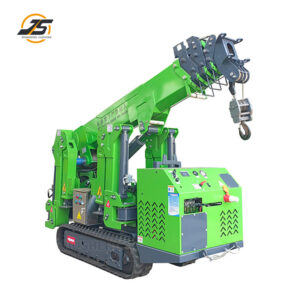
The tracked spider crane is an innovative lifting device that combines a tracked undercarriage with a multi-leg support structure. Thanks to its unique mechanical design, it demonstrates remarkable advantages in complex terrains and confined-space lifting operations. I. Structural Features Tracked Undercarriage: Equipped with rubber or steel tracks, providing low ground pressure for stable movement on soft surfaces such as mud, sand, or grass, minimizing the risk of sinking. Reduces damage to roads, making it suitable for urban streets and green areas. Multi-Leg Support Structure: Four fully hydraulic, auto-extending outriggers with 360-degree rotation capability. Adaptable to narrow passages, stairwells, and tight spaces in old residential areas, with a minimum passage width of just 1.2 meters. Compact Design: The overall dimensions are highly compact, allowing easy access through doorways, alleys, and other restricted areas. Suitable for both indoor and outdoor multi-scenario operations. II. Application Scenarios Indoor Operations: Ideal for factories, warehouses, and shopping malls, handling tasks such as equipment installation and material handling (e.g., machine tool relocation, elevator component lifting). Confined-Space Construction: Used in urban renewal projects and heritage building restoration, navigating narrow alleys and stairwells for tasks like steel structure assembly and pipeline installation. Let me know if you’d like any adjustments! -
5 Ton Spider Crane
The spider crane (also known as a tracked spider crane) is a compact lifting device specifically designed for confined spaces and complex working conditions. Its unique structure and functionality make it indispensable in industries such as construction, industrial maintenance, and power operations. Featuring four extendable outriggers and a tracked chassis, the spider crane can retract to a width of less than 1 meter, allowing it to easily navigate narrow passages (such as indoor corridors or stairwells) or access low-clearance areas (such as basements or factory interiors). For example, during the installation of glass curtain walls in high-rise buildings, the spider crane can be transported via elevator to the rooftop and deployed immediately for operation. The tracked chassis provides exceptional mobility, enabling stable operation on challenging terrains like mud, sand, or snow. For instance, during maintenance work in petrochemical plants, the spider crane can traverse uneven ground without the need for additional steel plates or wooden supports. The spider crane’s main boom can be equipped with a jib or a personnel platform, combining lifting and aerial work capabilities. In heritage restoration projects, for example, it can be fitted with a platform for roof tile replacement or timber structure repairs, eliminating the need for traditional scaffolding that could damage historic structures. The spider crane has become the go-to equipment for lifting operations in confined spaces. Its core advantages lie in its adaptability to complex conditions, enhanced safety, and reduced overall costs. For construction companies, deploying spider cranes not only expands project capabilities but also creates a competitive edge in a demanding market. Let me know if you’d like any refinements!
Show Next
-
10T Crane
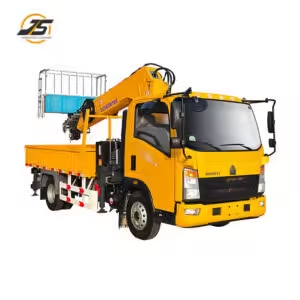
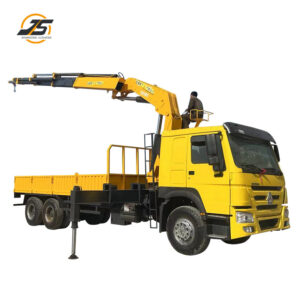
Truck-mounted crane transport vehicle (hereinafter referred to as “truck-mounted crane”) is a multi-functional engineering vehicle integrating cargo hoisting and transportation functions, which is widely used in construction sites, logistics and warehousing, municipal engineering, power repair, docks and ports, landscaping and other scenarios. The truck-mounted crane is mainly composed of the following parts: Chassis: Truck chassis, optional Dongfeng, Jiefang, Howo and other brands, tonnage covering 2 tons to 20 tons. The chassis provides driving power and stability to the vehicle. Crane: Installed on the chassis, the lifting, slewing and lifting of goods are realized through the hydraulic lifting and telescopic system. Cargo box: used for loading goods, the length can be configured according to demand. Outriggers: It is divided into front outriggers (under the crane frame) and rear outriggers (installed at the rear end of the chassis frame), which are used to maintain the stability and stability of the crane operation and increase the hoisting capacity. -
8T Crane
Truck-mounted crane transport vehicle (hereinafter referred to as “truck-mounted crane”) is a multi-functional engineering vehicle integrating cargo hoisting and transportation functions, which is widely used in construction sites, logistics and warehousing, municipal engineering, power repair, docks and ports, landscaping and other scenarios. The truck-mounted crane is mainly composed of the following parts: Chassis: Truck chassis, optional Dongfeng, Jiefang, Howo and other brands, tonnage covering 2 tons to 20 tons. The chassis provides driving power and stability to the vehicle. Crane: Installed on the chassis, the lifting, slewing and lifting of goods are realized through the hydraulic lifting and telescopic system. Cargo box: used for loading goods, the length can be configured according to demand. Outriggers: It is divided into front outriggers (under the crane frame) and rear outriggers (installed at the rear end of the chassis frame), which are used to maintain the stability and stability of the crane operation and increase the hoisting capacity. -
6T Crane
Truck-mounted crane transport vehicle (hereinafter referred to as “truck-mounted crane”) is a multi-functional engineering vehicle integrating cargo hoisting and transportation functions, which is widely used in construction sites, logistics and warehousing, municipal engineering, power repair, docks and ports, landscaping and other scenarios. The truck-mounted crane is mainly composed of the following parts: Chassis: Truck chassis, optional Dongfeng, Jiefang, Howo and other brands, tonnage covering 2 tons to 20 tons. The chassis provides driving power and stability to the vehicle. Crane: Installed on the chassis, the lifting, slewing and lifting of goods are realized through the hydraulic lifting and telescopic system. Cargo box: used for loading goods, the length can be configured according to demand. Outriggers: It is divided into front outriggers (under the crane frame) and rear outriggers (installed at the rear end of the chassis frame), which are used to maintain the stability and stability of the crane operation and increase the hoisting capacity. -
5T Crane
Truck-mounted crane transport vehicle (hereinafter referred to as “truck-mounted crane”) is a multi-functional engineering vehicle integrating cargo hoisting and transportation functions, which is widely used in construction sites, logistics and warehousing, municipal engineering, power repair, docks and ports, landscaping and other scenarios. The truck-mounted crane is mainly composed of the following parts: Chassis: Truck chassis, optional Dongfeng, Jiefang, Howo and other brands, tonnage covering 2 tons to 20 tons. The chassis provides driving power and stability to the vehicle. Crane: Installed on the chassis, the lifting, slewing and lifting of goods are realized through the hydraulic lifting and telescopic system. Cargo box: used for loading goods, the length can be configured according to demand. Outriggers: It is divided into front outriggers (under the crane frame) and rear outriggers (installed at the rear end of the chassis frame), which are used to maintain the stability and stability of the crane operation and increase the hoisting capacity.
Show Next
-
10 Tons Off-Road Forklift
Off-road forklifts, also known as field forklifts, are material-handling equipment designed for loading and unloading goods in areas with poor road conditions, such as airports, docks, and railway stations. They feature excellent mobility, off-road capability, and reliability. An off-road forklift typically consists of four main components: Engine Chassis Working mechanism Electrical system These forklifts are primarily used in: Urban construction sites Pipeline installation Oilfield development Mountainous and forested areas for field engineering Container handling at ports and freight yards Military logistics for transporting supplies during wartime Let me know if you’d like any adjustments! -
8 tons off-road forklift main technical parameters
Off-road forklifts, also known as field forklifts, are material-handling equipment designed for loading and unloading goods in areas with poor road conditions, such as airports, docks, and railway stations. They feature excellent mobility, off-road capability, and reliability. An off-road forklift typically consists of four main components: Engine、Chassis、Working mechanism、Electrical system These forklifts are primarily used in: Urban construction sites、Pipeline installation、Oilfield development、Mountainous and forested areas for field engineering、Container handling at ports and freight yards、Military logistics for transporting supplies during wartime Let me know if you’d like any adjustments! -
6 Tons Off-Road Forklift
Off-road forklifts are industrial vehicles specifically designed for complex terrains and harsh working conditions, featuring robust off-road capabilities and adaptability to multiple scenarios. They are widely used in construction, mining, agriculture, forestry, and logistics. I. Core Features Off-Road Performance: Equipped with four-wheel drive or full-time all-wheel-drive systems, paired with large-diameter, deep-tread tires to enhance traction on muddy, sandy, and rocky surfaces. Power System: Primarily powered by diesel engines, delivering high torque and extended endurance, making them ideal for heavy-load continuous operations. Reinforced Structure: The chassis is constructed with high-strength steel, improving torsional rigidity by over 30% to withstand rugged terrains. II. Core Application Scenarios Construction & Infrastructure: In construction waste yards or earthwork sites, off-road forklifts can quickly load debris, bricks, and other waste materials, adapting to muddy or uneven ground. Mining & Quarries: With a load capacity of 8–10 tons, they can transport ores and blasting equipment to open-pit mines, featuring a climbing ability of 35%–45% to meet steep slope operations in mining areas. Agricultural Transport: In orchards and farms, they move fruit crates and feed bags, while the tire tread design reduces soil compaction (pressure decreased by 20%–30%), protecting farmland structure. Forestry Operations: Equipped with log grapple attachments, they can load logs and branches onto transport vehicles, adapting to narrow mountain slopes. Let me know if you’d like any refinements! -
5 Tons Off-Road Forklift
Off-road forklifts are industrial vehicles specifically designed for complex terrains and harsh working conditions, featuring robust off-road capabilities and adaptability to multiple scenarios. They are widely used in construction, mining, agriculture, forestry, and logistics. I. Core Features Off-Road Performance: Equipped with four-wheel drive or full-time all-wheel-drive systems, paired with large-diameter, deep-tread tires to enhance traction on muddy, sandy, and rocky surfaces. Power System: Primarily powered by diesel engines, delivering high torque and extended endurance, making them ideal for heavy-load continuous operations. Reinforced Structure: The chassis is constructed with high-strength steel, improving torsional rigidity by over 30% to withstand rugged terrains. II. Core Application Scenarios Construction & Infrastructure: In construction waste yards or earthwork sites, off-road forklifts can quickly load debris, bricks, and other waste materials, adapting to muddy or uneven ground. Mining & Quarries: With a load capacity of 8–10 tons, they can transport ores and blasting equipment to open-pit mines, featuring a climbing ability of 35%–45% to meet steep slope operations in mining areas. Agricultural Transport: In orchards and farms, they move fruit crates and feed bags, while the tire tread design reduces soil compaction (pressure decreased by 20%–30%), protecting farmland structure. Forestry Operations: Equipped with log grapple attachments, they can load logs and branches onto transport vehicles, adapting to narrow mountain slopes. Let me know if you’d like any refinements!
Show Next
-
GK30 Aerial Work Platform
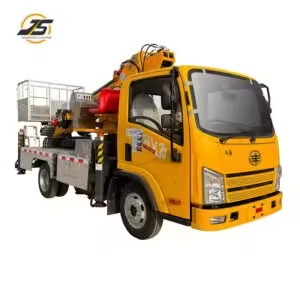
Aerial work platforms refer to movable mechanical equipment used for operations at certain heights. They lift workers, tools, and materials to specific positions for work, providing safety guarantees for operators. Aerial work platforms can replace traditional methods such as suspended baskets and scaffolding, significantly improving safety and efficiency. I. Features: Mobility: Can be easily moved to different work locations. High Safety: Provides safety guarantees for workers, reducing the risks of high-altitude operations. Improved Efficiency: Compared to traditional methods, they greatly enhance operational efficiency. Strong Adaptability: Various types are available to suit different operational needs and environmental conditions. II. Safety Operation Procedures: Pre-Operation Inspection: Check the structure for deformations. Ensure the hydraulic system’s oil level is normal; refill if insufficient. Inspect tire pressure to ensure it meets the specified range. Verify the braking system is sensitive and reliable to ensure stable parking. Test the flexibility of control handles to ensure precise operation. Before starting, clear surrounding debris to maintain an unobstructed workspace. Load Requirements: Overloading is strictly prohibited; the rated load capacity must not be exceeded. Movement Requirements: When moving the platform, speed should not be excessive and must remain within the specified limit. Let me know if you’d like any refinements! -
GK25 Aerial Work Platform
Aerial work platforms refer to movable mechanical equipment used for operations at certain heights. They lift workers, tools, and materials to specific positions for work, providing safety guarantees for operators. Aerial work platforms can replace traditional methods such as suspended baskets and scaffolding, significantly improving safety and efficiency. I. Features: Mobility: Can be easily moved to different work locations. High Safety: Provides safety guarantees for workers, reducing the risks of high-altitude operations. Improved Efficiency: Compared to traditional methods, they greatly enhance operational efficiency. Strong Adaptability: Various types are available to suit different operational needs and environmental conditions. II. Safety Operation Procedures: Pre-Operation Inspection: Check the structure for deformations. Ensure the hydraulic system’s oil level is normal; refill if insufficient. Inspect tire pressure to ensure it meets the specified range. Verify the braking system is sensitive and reliable to ensure stable parking. Test the flexibility of control handles to ensure precise operation. Before starting, clear surrounding debris to maintain an unobstructed workspace. Load Requirements: Overloading is strictly prohibited; the rated load capacity must not be exceeded. Movement Requirements: When moving the platform, speed should not be excessive and must remain within the specified limit. Let me know if you’d like any refinements! -
GK20 Aerial Work Platform
Aerial work platforms refer to movable mechanical equipment used for operations at certain heights. They lift workers, tools, and materials to specific positions for work, providing safety guarantees for operators. Aerial work platforms can replace traditional methods such as suspended baskets and scaffolding, significantly improving safety and efficiency. I. Features: Mobility: Can be easily moved to different work locations. High Safety: Provides safety guarantees for workers, reducing the risks of high-altitude operations. Improved Efficiency: Compared to traditional methods, they greatly enhance operational efficiency. Strong Adaptability: Various types are available to suit different operational needs and environmental conditions. II. Safety Operation Procedures: Pre-Operation Inspection: Check the structure for deformations. Ensure the hydraulic system’s oil level is normal; refill if insufficient. Inspect tire pressure to ensure it meets the specified range. Verify the braking system is sensitive and reliable to ensure stable parking. Test the flexibility of control handles to ensure precise operation. Before starting, clear surrounding debris to maintain an unobstructed workspace. Load Requirements: Overloading is strictly prohibited; the rated load capacity must not be exceeded. Movement Requirements: When moving the platform, speed should not be excessive and must remain within the specified limit. Let me know if you’d like any refinements!
Show Next
-
20T Boom
The boom is the core component of lifting equipment (such as truck cranes, crawler cranes, marine cranes, knuckle boom cranes, etc.), enabling cargo lifting and positioning through telescoping, slewing, or folding. Its design directly affects the crane’s lifting capacity, working radius, and applicable scenarios. Basic Components: Main Boom: The foundational support structure, typically designed as a box-type or truss configuration, providing the primary load-bearing capacity. Jib (Optional): Attached to the top of the main boom to extend the working radius or increase lifting height, suitable for specialized operations (e.g., high-rise building construction). Telescoping Mechanism: Adjusts boom length via hydraulic or mechanical transmission, with some booms supporting multi-stage synchronous extension. Connection Joints: Utilize high-strength bolts or pin connections to ensure structural stability. -
16T Boom
The boom is the core component of lifting equipment (such as truck cranes, crawler cranes, marine cranes, knuckle boom cranes, etc.), enabling cargo lifting and positioning through telescoping, slewing, or folding. Its design directly affects the crane’s lifting capacity, working radius, and applicable scenarios. Basic Components: Main Boom: The foundational support structure, typically designed as a box-type or truss configuration, providing the primary load-bearing capacity. Jib (Optional): Attached to the top of the main boom to extend the working radius or increase lifting height, suitable for specialized operations (e.g., high-rise building construction). Telescoping Mechanism: Adjusts boom length via hydraulic or mechanical transmission, with some booms supporting multi-stage synchronous extension. Connection Joints: Utilize high-strength bolts or pin connections to ensure structural stability. -
14T Boom
The boom is the core component of lifting equipment (such as truck cranes, crawler cranes, marine cranes, knuckle boom cranes, etc.), enabling cargo lifting and positioning through telescoping, slewing, or folding. Its design directly affects the crane’s lifting capacity, working radius, and applicable scenarios. Basic Components: Main Boom: The foundational support structure, typically designed as a box-type or truss configuration, providing the primary load-bearing capacity. Jib (Optional): Attached to the top of the main boom to extend the working radius or increase lifting height, suitable for specialized operations (e.g., high-rise building construction). Telescoping Mechanism: Adjusts boom length via hydraulic or mechanical transmission, with some booms supporting multi-stage synchronous extension. Connection Joints: Utilize high-strength bolts or pin connections to ensure structural stability. -
12T Boom
The boom is the core component of lifting equipment (such as truck cranes, crawler cranes, marine cranes, knuckle boom cranes, etc.), enabling cargo lifting and positioning through telescoping, slewing, or folding. Its design directly affects the crane’s lifting capacity, working radius, and applicable scenarios. Basic Components: Main Boom: The foundational support structure, typically designed as a box-type or truss configuration, providing the primary load-bearing capacity. Jib (Optional): Attached to the top of the main boom to extend the working radius or increase lifting height, suitable for specialized operations (e.g., high-rise building construction). Telescoping Mechanism: Adjusts boom length via hydraulic or mechanical transmission, with some booms supporting multi-stage synchronous extension. Connection Joints: Utilize high-strength bolts or pin connections to ensure structural stability.
Show Next
-
T35 Rough Terrain Forklift Tail Crane
Rough Terrain Forklift Tail Crane A rough terrain forklift tail crane is a specialized lifting device that integrates a boom attachment onto a forklift. Below is a detailed introduction to its structural features, working principles, and applications. 1. Structural Features Boom Design: The crane boom is typically telescopic and straight-arm, allowing adjustment for various lifting needs. The boom can swivel at different angles, enabling low-level and high-level material handling. Mounting System: The crane is usually connected to the forklift forks via a sleeve mechanism, utilizing the forklift’s existing hydraulic system with quick-release couplings for easy installation and removal. Space Efficiency: The boom can be folded downward when not in use, minimizing space occupation and allowing the forklift to maneuver, turn, and operate even in tight spaces. 2. Working Principle Hydraulic Drive: The crane operates via a hydraulic transmission system, where the forklift’s hydraulic pump supplies power. Control valves regulate oil flow to drive hydraulic cylinders, enabling boom extension, retraction, lifting, and lowering. Ease of Operation: The rough terrain forklift tail crane is user-friendly, safe, reliable, and highly mobile, offering high efficiency and versatility. 3. Applications Confined Space Operations: Due to its compact size and agility, the rough terrain forklift tail crane is ideal for lifting tasks in narrow spaces inaccessible to traditional cranes, such as alleys, low-ceiling workshops, basements, and multi-floor buildings. Aerial Work: With the boom extended and the forklift’s mast raised, it can reach considerable heights (e.g., 13 meters), making it suitable for streetlight installation, billboard mounting, and AC unit placement. Warehousing & Logistics: The crane can handle bulk bag unloading, doorway installations, and other material-handling tasks. Landscaping: It efficiently transports saplings and trees for landscaping projects. Roadside Rescue & Construction: The forklift crane is also used in emergency recovery and small-scale construction sites. -
T50 Rough Terrain Forklift Tail Crane
Rough Terrain Forklift Tail Crane A rough terrain forklift tail crane is a specialized lifting device that integrates a boom attachment onto a forklift. Below is a detailed introduction to its structural features, working principles, and applications. 1. Structural Features Boom Design: The crane boom is typically telescopic and straight-arm, allowing adjustment for various lifting needs. The boom can swivel at different angles, enabling low-level and high-level material handling. Mounting System: The crane is usually connected to the forklift forks via a sleeve mechanism, utilizing the forklift’s existing hydraulic system with quick-release couplings for easy installation and removal. Space Efficiency: The boom can be folded downward when not in use, minimizing space occupation and allowing the forklift to maneuver, turn, and operate even in tight spaces. 2. Working Principle Hydraulic Drive: The crane operates via a hydraulic transmission system, where the forklift’s hydraulic pump supplies power. Control valves regulate oil flow to drive hydraulic cylinders, enabling boom extension, retraction, lifting, and lowering. Ease of Operation: The rough terrain forklift tail crane is user-friendly, safe, reliable, and highly mobile, offering high efficiency and versatility. 3. Applications Confined Space Operations: Due to its compact size and agility, the rough terrain forklift tail crane is ideal for lifting tasks in narrow spaces inaccessible to traditional cranes, such as alleys, low-ceiling workshops, basements, and multi-floor buildings. Aerial Work: With the boom extended and the forklift’s mast raised, it can reach considerable heights (e.g., 13 meters), making it suitable for streetlight installation, billboard mounting, and AC unit placement. Warehousing & Logistics: The crane can handle bulk bag unloading, doorway installations, and other material-handling tasks. Landscaping: It efficiently transports saplings and trees for landscaping projects. Roadside Rescue & Construction: The forklift crane is also used in emergency recovery and small-scale construction sites. -
T60 Rough Terrain Forklift Tail Crane
Rough Terrain Forklift Tail Crane A rough terrain forklift tail crane is a specialized lifting device that integrates a boom attachment onto a forklift. Below is a detailed introduction to its structural features, working principles, and applications. 1. Structural Features Boom Design: The crane boom is typically telescopic and straight-arm, allowing adjustment for various lifting needs. The boom can swivel at different angles, enabling low-level and high-level material handling. Mounting System: The crane is usually connected to the forklift forks via a sleeve mechanism, utilizing the forklift’s existing hydraulic system with quick-release couplings for easy installation and removal. Space Efficiency: The boom can be folded downward when not in use, minimizing space occupation and allowing the forklift to maneuver, turn, and operate even in tight spaces. 2. Working Principle Hydraulic Drive: The crane operates via a hydraulic transmission system, where the forklift’s hydraulic pump supplies power. Control valves regulate oil flow to drive hydraulic cylinders, enabling boom extension, retraction, lifting, and lowering. Ease of Operation: The rough terrain forklift tail crane is user-friendly, safe, reliable, and highly mobile, offering high efficiency and versatility. 3. Applications Confined Space Operations: Due to its compact size and agility, the rough terrain forklift tail crane is ideal for lifting tasks in narrow spaces inaccessible to traditional cranes, such as alleys, low-ceiling workshops, basements, and multi-floor buildings. Aerial Work: With the boom extended and the forklift’s mast raised, it can reach considerable heights (e.g., 13 meters), making it suitable for streetlight installation, billboard mounting, and AC unit placement. Warehousing & Logistics: The crane can handle bulk bag unloading, doorway installations, and other material-handling tasks. Landscaping: It efficiently transports saplings and trees for landscaping projects. Roadside Rescue & Construction: The forklift crane is also used in emergency recovery and small-scale construction sites. -
T80 Rough Terrain Forklift Tail Crane
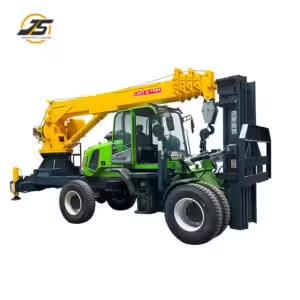
Rough Terrain Forklift Tail Crane A rough terrain forklift tail crane is a specialized lifting device that integrates a boom attachment onto a forklift. Below is a detailed introduction to its structural features, working principles, and applications. 1. Structural Features Boom Design: The crane boom is typically telescopic and straight-arm, allowing adjustment for various lifting needs. The boom can swivel at different angles, enabling low-level and high-level material handling. Mounting System: The crane is usually connected to the forklift forks via a sleeve mechanism, utilizing the forklift’s existing hydraulic system with quick-release couplings for easy installation and removal. Space Efficiency: The boom can be folded downward when not in use, minimizing space occupation and allowing the forklift to maneuver, turn, and operate even in tight spaces. 2. Working Principle Hydraulic Drive: The crane operates via a hydraulic transmission system, where the forklift’s hydraulic pump supplies power. Control valves regulate oil flow to drive hydraulic cylinders, enabling boom extension, retraction, lifting, and lowering. Ease of Operation: The rough terrain forklift tail crane is user-friendly, safe, reliable, and highly mobile, offering high efficiency and versatility. 3. Applications Confined Space Operations: Due to its compact size and agility, the rough terrain forklift tail crane is ideal for lifting tasks in narrow spaces inaccessible to traditional cranes, such as alleys, low-ceiling workshops, basements, and multi-floor buildings. Aerial Work: With the boom extended and the forklift’s mast raised, it can reach considerable heights (e.g., 13 meters), making it suitable for streetlight installation, billboard mounting, and AC unit placement. Warehousing & Logistics: The crane can handle bulk bag unloading, doorway installations, and other material-handling tasks. Landscaping: It efficiently transports saplings and trees for landscaping projects. Roadside Rescue & Construction: The forklift crane is also used in emergency recovery and small-scale construction sites.
Show Next
-
16 T Knuckle Boom Crane
The knuckle boom crane is a kind of lifting equipment, which has the characteristics of flexibility, efficiency, safety and reliability, and can be installed behind the cab of the automobile chassis, which can realize 360° full-range hoisting operations, with large lifting torque and small working space. -
12 T Knuckle Boom Crane
The knuckle boom crane is a kind of lifting equipment, which has the characteristics of flexibility, efficiency, safety and reliability, and can be installed behind the cab of the automobile chassis, which can realize 360° full-range hoisting operations, with large lifting torque and small working space. -
10 T Knuckle Boom Crane
The knuckle boom crane is a kind of lifting equipment, which has the characteristics of flexibility, efficiency, safety and reliability, and can be installed behind the cab of the automobile chassis, which can realize 360° full-range hoisting operations, with large lifting torque and small working space. -
8 T Knuckle Boom Crane
The knuckle boom crane is a kind of lifting equipment, which has the characteristics of flexibility, efficiency, safety and reliability, and can be installed behind the cab of the automobile chassis, which can realize 360° full-range hoisting operations, with large lifting torque and small working space.
Show Next
-
16m Articulating Boom Lift
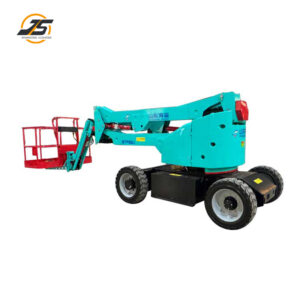
A self-propelled articulated boom lift is a versatile equipment combining mobility and aerial work capabilities. Below is an introduction covering its structural features, working principles, applications, and advantages/disadvantages. Structural Features Compact & Flexible: Designed with a compact structure and agile steering, offering high chassis stability for narrow passages and congested workspaces. Multi-Section Articulated Boom: Utilizes a multi-stage folding boom system for extended outreach, paired with a 360° rotating platform for enhanced range. Dual-Power System: Equipped with both diesel and electric drive modes to adapt to diverse energy needs. Safety Mechanisms: Integrates triple protection (mechanical, electrical, and hydraulic) and features a unified hydraulic-electrical control system. Working Principle The hydraulic drive system powers cylinder extensions/retractions, enabling boom folding/extension for platform elevation and positioning. The power unit (diesel engine or battery) supplies energy for movement and operations. The control panel allows simultaneous travel and aerial work, with continuous operation possible at any elevated position. Applications Municipal & Electrical: Streetlight maintenance, billboard installation, and power facility repairs. Construction & Industrial: Bridge construction, high-rise facade cleaning, factory maintenance, and shipbuilding. Public Facilities: Ceiling/lighting maintenance in stations, hospitals, and shopping malls.
Show Next
-
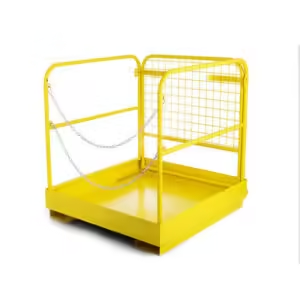
forklift basket
高空作业篮是一种特殊的高空作业设备,型号包括普通高空作业篮、旋转高空作业篮和电动高空作业 篮。它适用于我厂生产的各种起重机,兼具起重机的灵活性和作业篮的安全性,使操作人员能够在高空进行全方位作业。这种作业篮尤其适用于需要在固定点周围进行全面施工、维护或检查的作业。它无需重新定位起重机即可改变工作角度,大大缩短了准备时间和劳动强度。 -
Manual Aerial Basket
Aerial basket is a special high-altitude operation equipment, with models including ordinary aerial basket, rotating aerial basket, and electric aerial basket. It is suitable for any type of crane produced in our factory, combining the flexibility of the crane and the safety of the basket, allowing operators to carry out all-round work at heights. This type of basket is particularly suitable for tasks that require comprehensive construction, maintenance, or inspection around fixed points. It can change the working angle without repositioning the crane, greatly reducing preparation time and labor intensity. -
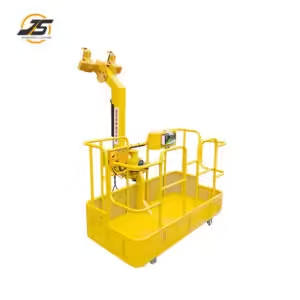
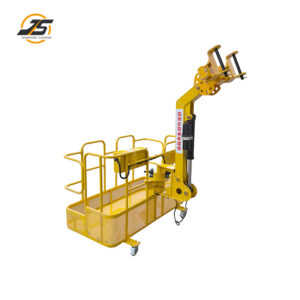
Electric Aerial Basket
Aerial basket is a special high-altitude operation equipment, with models including ordinary aerial basket, rotating aerial basket, and electric aerial basket. It is suitable for any type of crane produced in our factory, combining the flexibility of the crane and the safety of the hanging basket, allowing operators to carry out all-round work at heights. This type of hanging basket is particularly suitable for tasks that require comprehensive construction, maintenance, or inspection around fixed points. It can change the working angle without repositioning the crane, greatly reducing preparation time and labor intensity.
Show Next
-
16T Marine Cranes
Marine cranes are lifting equipment installed on ship decks, primarily used for cargo handling, equipment installation, and underwater operations. Their design must adapt to marine environments, offering high flexibility and multifunctionality. I. Core Components: Boom: Telescopic or foldable to enable cargo lifting at various radii. Slewing Mechanism: Supports 360-degree rotation, enhancing operational flexibility. Hoisting Mechanism: Includes winches, wire ropes, and hooks for lifting and lowering cargo. Power System: Typically driven by the ship’s built-in motor or hydraulic system. II. Advantages: High Flexibility: 360-degree rotation and adjustable boom adapt to complex working conditions. Multifunctionality: Integrates lifting, transporting, and positioning functions, reducing equipment switching costs. Environmental Adaptability: Features anti-corrosion materials and sealed designs for stable operation in harsh sea conditions. Marine cranes are essential for port cargo handling, particularly suited for bulk goods, containers, and heavy equipment lifting. -
12T Marine Cranes
Marine cranes are lifting equipment installed on ship decks, primarily used for cargo handling, equipment installation, and underwater operations. Their design must adapt to marine environments, offering high flexibility and multifunctionality. I. Core Components: Boom: Telescopic or foldable to enable cargo lifting at various radii. Slewing Mechanism: Supports 360-degree rotation, enhancing operational flexibility. Hoisting Mechanism: Includes winches, wire ropes, and hooks for lifting and lowering cargo. Power System: Typically driven by the ship’s built-in motor or hydraulic system. II. Advantages: High Flexibility: 360-degree rotation and adjustable boom adapt to complex working conditions. Multifunctionality: Integrates lifting, transporting, and positioning functions, reducing equipment switching costs. Environmental Adaptability: Features anti-corrosion materials and sealed designs for stable operation in harsh sea conditions. Marine cranes are essential for port cargo handling, particularly suited for bulk goods, containers, and heavy equipment lifting. -
8T Marine Cranes
Marine cranes are lifting equipment installed on ship decks, primarily used for cargo handling, equipment installation, and underwater operations. Their design must adapt to marine environments, offering high flexibility and multifunctionality. I. Core Components: Boom: Telescopic or foldable to enable cargo lifting at various radii. Slewing Mechanism: Supports 360-degree rotation, enhancing operational flexibility. Hoisting Mechanism: Includes winches, wire ropes, and hooks for lifting and lowering cargo. Power System: Typically driven by the ship’s built-in motor or hydraulic system. II. Advantages: High Flexibility: 360-degree rotation and adjustable boom adapt to complex working conditions. Multifunctionality: Integrates lifting, transporting, and positioning functions, reducing equipment switching costs. Environmental Adaptability: Features anti-corrosion materials and sealed designs for stable operation in harsh sea conditions. Marine cranes are essential for port cargo handling, particularly suited for bulk goods, containers, and heavy equipment lifting. -
6T Marine Cranes
Marine cranes are lifting equipment installed on ship decks, primarily used for cargo handling, equipment installation, and underwater operations. Their design must adapt to marine environments, offering high flexibility and multifunctionality. I. Core Components: Boom: Telescopic or foldable to enable cargo lifting at various radii. Slewing Mechanism: Supports 360-degree rotation, enhancing operational flexibility. Hoisting Mechanism: Includes winches, wire ropes, and hooks for lifting and lowering cargo. Power System: Typically driven by the ship’s built-in motor or hydraulic system. II. Advantages: High Flexibility: 360-degree rotation and adjustable boom adapt to complex working conditions. Multifunctionality: Integrates lifting, transporting, and positioning functions, reducing equipment switching costs. Environmental Adaptability: Features anti-corrosion materials and sealed designs for stable operation in harsh sea conditions. Marine cranes are essential for port cargo handling, particularly suited for bulk goods, containers, and heavy equipment lifting.
Show Next
What we offer
Make every customization precise and innovative
Jiusheng focuses on the customization of intelligent equipment. With a professional team of engineers and advanced technology, we can create exclusive equipment that meets your needs. From urban and rural construction to port operations, we help scenes operate efficiently.

Customized solution delivery
In-depth communication of needs, rapid response to design, on-time delivery of exclusive equipment, and transparent collaboration throughout the entire process.

Equipment debugging and optimization
Careful debugging before delivery ensures convenient operation, stable performance, and adaptability to complex operating scenarios.

Full-cycle technical support
After the customized equipment is put into use, we will continue to provide technical maintenance and upgrade guidance to ensure long-term reliable operation.
Start a customized solution
Want to build your own lifting equipment?
Get a Quote Right Now
Certification
Use strength to back up customization
At Shandong Jiusheng, we use our authoritative qualifications to lay a solid foundation for the quality of customized lifting equipment.
Required Blog Post
Check Out our Most Recent Articles
-
An upgraded off-road forklift fitted with a tail-mounted crane has been put into use across multiple working scenarios. The equipment combines cross-country travel performance and tail hoisting functions, supporting cargo transportation, stacking and component hoisting in outdoor environments. Different from separate forklift and crane equipment, the integrated model saves working space and simplifies equipment scheduling. […]
-
A versatile off-road forklift integrated with a rear lifting attachment has drawn wide attention in engineering and material handling sectors. Built to adapt to uneven, muddy and rough terrain, the combined equipment merges the load-shifting capability of off-road forklifts and the hoisting function of rear cranes. Work teams can finish both cargo stacking and light […]
-
As various engineering projects tend to be refined and diversified, the market has put forward higher requirements for the versatility and practicability of lifting machinery. Knuckle boom cranes stand out in the field of light and medium-duty lifting operations by virtue of their reasonable structural design, stable performance and diverse functional attributes, and are widely […]
-
With the continuous upgrading of modern construction, municipal engineering and logistics handling standards, the demand for adaptable lifting equipment has grown significantly. Traditional cranes are often restricted by large body size and fixed boom structures, making it difficult to operate in narrow and complex working environments. In this context, knuckle boom cranes have become a […]
-
Spider cranes have become a common sight on building projects because they bring lifting power to places full-size cranes cannot go. Their main strength is the ability to work close to structures and over edges. In glass curtain wall installation, the crane lifts panels from ground level and places them gently at the correct height, […]
-
Spider cranes, also known as mini crawler cranes, are compact lifting machines built for work sites where room is limited. Their narrow body allows them to pass through standard doorways and fit into passenger elevators, so they can reach floors that ordinary cranes cannot access. Their track chassis spreads ground pressure evenly, protecting finished floors […]
-
As a widely used small lifting device in engineering construction, spider cranes’ operating stability and service cycle are closely related to daily standardized maintenance and routine inspection. Scientific maintenance habits can effectively reduce equipment failure rates and ensure smooth progress of construction operations.Professional mechanical maintenance technicians have summarized practical daily maintenance specifications for spider cranes. […]
-
Urban construction and renovation projects often face challenges brought by narrow working spaces, dense buildings and limited ground access. Traditional large lifting equipment is difficult to deploy in crowded urban areas, making small and flexible lifting machinery essential for modern infrastructure maintenance and upgrading.In recent years, spider cranes have gradually become a common lifting solution […]
-
Knuckle boom cranes are highly adaptable functional lifting equipment, widely applied in construction engineering, logistics transportation, municipal maintenance, factory handling and many other fields. Its core advantage lies in excellent maneuverability in complex and narrow working environments, making up for the insufficient flexibility of traditional cranes in diversified operation scenarios. In urban construction and renovation […]
-
A knuckle boom crane, also widely referred to as an articulating or folding boom crane, is a versatile hydraulic lifting device designed for flexible and efficient material handling. Different from traditional straight boom cranes, it adopts a multi-joint folding boom structure, which enables flexible bending and rotating movements in narrow and complex working spaces. This […]
-
A batch of truck‑mounted knuckle boom crane units has finished factory testing and been prepared for shipment to overseas clients for infrastructure and material‑handling projects. These knuckle boom crane trucks combine standard truck chassis with folding hydraulic lifting modules. Compared with fixed‑location cranes, they offer good mobility for fast relocation between different work sites without […]
-
In modern material handling and logistics operations, versatility and efficiency are key factors in equipment selection. A forklift tail crane—also known as a forklift-mounted jib crane or forklift tail lift—is an attachment that integrates a lifting boom onto the rear of a standard forklift. It combines the forklift’s mobility with crane-like hoisting capability, enabling both […]
Help Center
Get Answers to Your Questions
At Shandong Jiusheng, we prioritize your experience in customizing your lifting equipment.
How to start customization?
Visit our site, select the product, click “Customize Now”, fill in requirements and submit.
Check design solutions before confirmation?
Yes. Our team provides preliminary designs for your review after you submit basic info.
Info needed for customization?
Working scenarios, performance needs, special designs, and contact details.
Modify confirmed plan?
Early minor changes allowed; contact us promptly for adjustments.
Deposit for customization?
Yes, a deposit (50% of the total cost) is required to get started.
Get a quote before finalizing?
Sure. Submit requirements and our team will provide a detailed quote.