
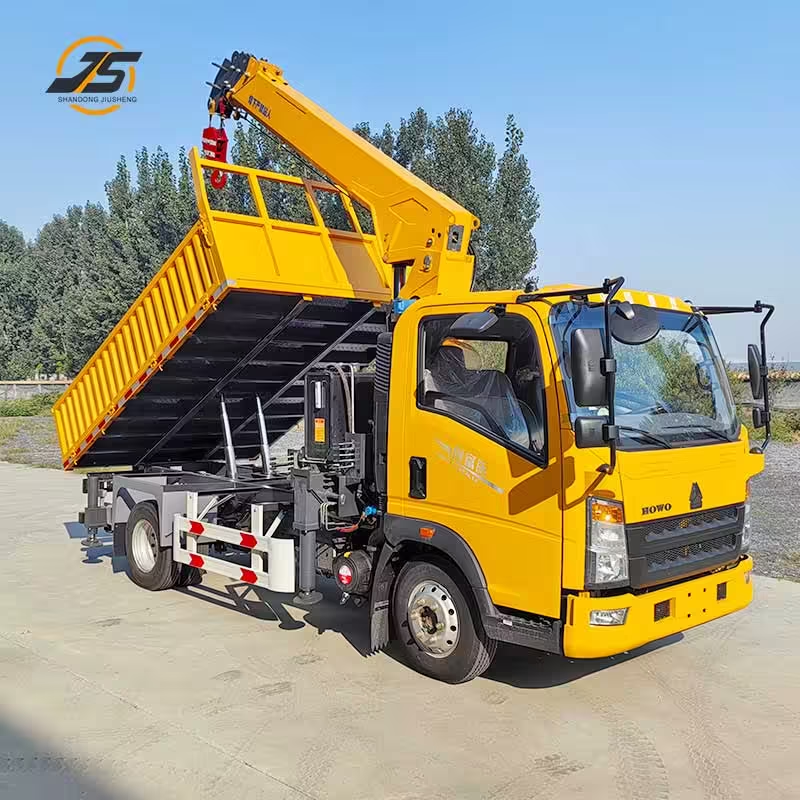
A truck mounted crane is becoming one of the most practical lifting solutions for contractors, logistics teams, municipal service departments, utility crews, and industrial buyers who need more than a crane alone. Unlike equipment that only lifts, a truck mounted crane combines hoisting, loading, transport, and site-to-site mobility in one working platform.
For buyers, the real question is not simply “How much can it lift?” A better question is: Can this truck mounted crane complete the job safely, move efficiently between sites, fit the operating environment, and support long-term productivity?
This guide explains how to choose the right truck mounted crane from a practical buyer’s perspective. It covers lifting capacity, boom reach, hydraulic performance, chassis selection, outriggers, load charts, work scenarios, and safety planning—without focusing only on headline lifting tonnage.
For buyers comparing available models, the truck crane product range is a useful starting point for understanding different lifting capacities and configurations.
Table of Contents
Why Truck Mounted Crane Demand Is Growing

Modern projects are becoming more fragmented. A construction team may need to unload steel beams in the morning, move building materials across town in the afternoon, and assist with installation at another site the next day. Logistics yards, power repair teams, landscaping contractors, and municipal departments face similar challenges.
A truck mounted crane solves this by combining three functions:
- It drives to the jobsite.
- It lifts or loads heavy materials.
- It transports cargo after lifting.
This “lift-and-carry” value is why many buyers prefer a truck mounted crane over using separate lifting and transport equipment. It reduces equipment coordination, saves working space, and supports faster response in jobs where mobility matters.
A truck mounted crane is especially useful for:
- Construction material delivery
- Machinery loading and unloading
- Utility pole and power repair work
- Municipal maintenance
- Landscaping and tree-related lifting
- Workshop and warehouse material handling
- Dock, yard, and logistics operations
- Rural and urban infrastructure projects
For companies that handle both lifting and transport, a truck mounted crane is not just a piece of lifting equipment. It becomes a mobile working unit.
Truck Mounted Crane vs. Other Lifting Equipment
A truck mounted crane should not be selected only because it is flexible. It should be selected when its strengths match the project.
Compared with fixed lifting equipment, a truck mounted crane offers better mobility. Compared with larger mobile cranes, it is usually easier to deploy for short-duration lifting tasks. Compared with forklifts, it can lift materials over obstacles, onto platforms, or directly onto the truck bed.
However, it is not the best choice for every situation. If a job requires extremely high lifting capacity at long radius, a different crane type may be more suitable. If the working space is extremely narrow, a compact solution such as a spider crane may be more appropriate. If the project requires frequent articulated movement around obstacles, buyers may also compare knuckle boom crane options.
The best decision depends on the work pattern:
| Work Requirement | Suitable Equipment Direction |
|---|---|
| Lift and transport materials between sites | Truck mounted crane |
| Work in compact indoor or narrow areas | Spider crane |
| Reach around obstacles with folding movement | Knuckle boom crane |
| Lift personnel for overhead access | Aerial work platform |
| Handle general warehouse movement | Forklift or forklift crane |
The key is to match the crane to the real operating environment rather than choosing based on maximum lifting capacity alone.
Start With the Load: Weight, Shape, and Lifting Frequency
The first step in choosing a truck mounted crane is understanding the load.
Buyers often focus on maximum lifting weight, but actual lifting performance depends on several details:
- The weight of the load
- The size and center of gravity
- Whether the load is compact or long
- How often the crane will lift during a normal workday
- Whether the load must be lifted from the side, rear, or front area
- How far the load must be placed from the truck
A compact load lifted close to the crane requires less working radius. A long pipe, steel frame, containerized component, or irregular machine may require more careful rigging and positioning.
This is why professional buyers should prepare a simple lifting profile before selecting equipment:
- Typical load weight
- Heaviest expected load
- Required lifting height
- Required horizontal reach
- Loading direction
- Ground condition
- Daily operating frequency
Once this information is clear, the supplier can recommend a more accurate model instead of only matching a tonnage number.
Understand Boom Reach, Lifting Height, and Working Radius
A truck mounted crane’s capacity changes depending on boom extension and working radius. The crane may lift more when the boom is shorter and the load is closer. As the boom extends outward, the safe lifting capacity decreases.
This is where many inexperienced buyers make mistakes. They see the maximum lifting weight and assume the crane can lift that same load at full reach. In real applications, the actual lifting capacity must be checked according to the load chart.
International crane safety discussions place strong emphasis on load charts and rated capacity. For example, ISO 11661 addresses the presentation of rated capacity charts for mobile cranes, while OSHA crane and derrick safety standards highlight the importance of safe operation and compliance.
When selecting a truck mounted crane, buyers should consider:
- Maximum lifting height
- Maximum boom length
- Capacity at common working radius
- Capacity over the side and rear
- Boom angle range
- Rotation angle
- Stability with outriggers deployed
A good buying decision is not based on the best number in the specification sheet. It is based on whether the crane can safely complete the most common lifts in real working conditions.
Straight Boom or Knuckle Boom: Which Is Better?

Truck mounted cranes usually use different boom structures depending on the lifting task.
A straight boom crane is often preferred when the job needs vertical lifting height, simple operation, and direct loading or unloading. It is suitable for construction materials, equipment movement, and general lifting tasks.
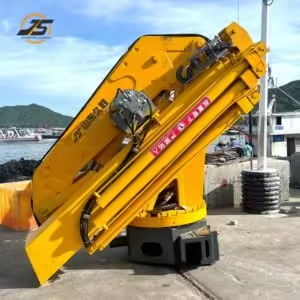
A knuckle boom crane is useful when the operator needs more flexible movement. Its folding arm structure can help position loads around obstacles, reduce storage length, and support compact transport.
Here is a simple comparison:
| Feature | Straight Boom Truck Mounted Crane | Knuckle Boom Truck Mounted Crane |
| Main advantage | Height and direct reach | Flexible folding movement |
| Common use | Construction, loading, municipal work | Urban delivery, obstacle-heavy sites |
| Storage style | Extended boom structure | Foldable arm structure |
| Operation focus | Vertical lift and radius | Precise placement and compact folding |
| Best for | General lifting and transport | Tight placement and flexible handling |
Buyers who need a standard lift-and-carry solution can start with a truck mounted crane. Buyers needing more articulated movement can compare knuckle boom crane solutions.
Chassis Selection: The Foundation of the Crane
The crane is only one part of the machine. The chassis is equally important because it affects driving performance, load distribution, stability, wheelbase, cargo box size, and long-term durability.
When evaluating the chassis, buyers should consider:
- Road condition
- Worksite terrain
- Payload requirement
- Wheelbase
- Cargo box size
- Engine power
- Braking system
- Tire specification
- Local transport rules
- Maintenance accessibility
A truck mounted crane used mainly in city delivery may require different chassis priorities from one used in rural infrastructure work. Urban users may care more about maneuverability and compact turning. Heavy-duty users may focus on structural strength, traction, and loading space.
The right chassis should support both transport and lifting. If the chassis is undersized, the whole machine may suffer from poor stability and reduced service life. If it is oversized for the application, operation may become less efficient in compact sites.
This is why buyers should discuss actual working scenarios before confirming specifications. The contact page can be used to submit working conditions, lifting requirements, and customization needs.
Outriggers and Stability: The Safety Detail Buyers Cannot Ignore
Outriggers are critical for truck mounted crane safety. They extend the support base and help stabilize the vehicle during lifting. Without proper outrigger deployment, even a correctly sized crane can become unsafe.
Before purchasing, buyers should check:
- Outrigger span
- Front and rear outrigger configuration
- Ground contact area
- Ease of deployment
- Hydraulic control reliability
- Stability under side lifting
- Working requirements on uneven ground
Safe lifting depends on the interaction between crane, chassis, outriggers, ground, and load. The operator must also evaluate ground bearing capacity before lifting. Soft soil, underground voids, weak pavement, slopes, and uneven surfaces can all affect stability.
The OSHA Cranes & Derricks in Construction guidance is a helpful reference for understanding the broader safety environment around crane operations. In addition, ASME B30.5 is widely recognized for mobile and locomotive crane safety practices.
A buyer should never treat outriggers as a secondary detail. In many lifting jobs, stability is more important than rated capacity.
Hydraulic System Performance Matters More Than Many Buyers Realize
A truck mounted crane depends on hydraulic power for lifting, telescoping, slewing, and outrigger movement. A strong hydraulic system helps the crane operate smoothly and efficiently.
Important hydraulic factors include:
- Rated working pressure
- System flow
- Oil tank capacity
- Heat management
- Sealing quality
- Control response
- Smoothness of boom movement
- Maintenance accessibility
A crane that looks powerful on paper may feel slow or unstable if the hydraulic system is poorly matched. For frequent lifting tasks, smooth hydraulic control helps reduce operator fatigue and improves placement accuracy.
Hydraulic performance is especially important in:
- Repeated loading and unloading
- Precision equipment placement
- Municipal repair tasks
- Utility maintenance
- Jobs requiring frequent boom extension
- Sites where smooth load control is essential
Buyers should ask not only “What is the maximum capacity?” but also “How does the crane perform during repeated daily operation?”
Match the Truck Mounted Crane to Real Jobsite Scenarios
Different industries use truck mounted cranes in different ways. A practical buying guide must look beyond general specifications and consider use cases.
Construction Sites
Construction buyers often use truck mounted cranes to lift steel, timber, formwork, pipes, prefabricated components, and tools. The most important factors are lifting height, working radius, stability, and cargo space.
Logistics and Warehousing
Logistics teams need fast loading and unloading. A truck mounted crane can reduce dependence on external loading equipment and help move heavy materials directly from truck to ground or storage area.
Municipal Engineering
Municipal users may need to lift road equipment, drainage components, lighting poles, guardrails, public facility parts, and maintenance tools. Mobility and quick deployment are especially valuable.
Power and Utility Repair
Utility work often requires flexible positioning, stable lifting, and reliable hydraulic movement. The crane may need to work near roads, poles, or uneven ground, so stability planning is essential.
Landscaping and Outdoor Projects
For landscaping, a truck mounted crane can lift stones, trees, garden structures, and outdoor materials. Buyers should consider terrain conditions and outrigger support.
Ports, Docks, and Yards
Material movement in docks and yards often requires both lifting and short-distance transport. A truck mounted crane can improve handling efficiency when paired with the right cargo body and boom configuration.
For buyers comparing multiple lifting categories, the full lifting equipment product page can help organize options by application.
How to Read Specifications Without Being Misled
A specification sheet is useful, but only when buyers know how to interpret it.
Here are the most important specifications to review:
| Specification | Why It Matters |
| Maximum lifting weight | Shows the upper lifting limit under specific conditions |
| Maximum lifting moment | Helps evaluate real lifting strength at radius |
| Maximum arm length | Affects reach and work flexibility |
| Maximum lifting height | Important for construction and installation |
| Rotation angle | Determines working coverage around the truck |
| Outrigger span | Directly affects stability |
| Hydraulic pressure | Indicates hydraulic working capability |
| System flow | Affects movement speed and smoothness |
| Cargo box size | Determines transport usefulness |
| Wheelbase | Affects stability, turning, and load distribution |
A professional buyer should never isolate one specification. For example, a longer boom is useful only if the crane can safely lift the required load at that reach. A high lifting capacity is useful only if the chassis and outriggers support stable operation.
This is why load charts, working radius, and site conditions must be reviewed together.
Key Questions to Ask Before Buying a Truck Mounted Crane

Before choosing a truck mounted crane, buyers should prepare answers to these questions:
- What materials will the crane lift most often?
- What is the typical lifting weight?
- What is the maximum lifting weight?
- How far must the load be placed from the truck?
- What lifting height is required?
- Will the crane work mainly in cities, factories, rural areas, or construction sites?
- What road conditions will the truck face?
- Does the job require side lifting or rear lifting?
- How much cargo space is needed?
- Are there local safety or certification requirements?
- Will operators need training support?
- Is customization required for the cargo box, outriggers, boom, or control system?
These questions help prevent under-specification and over-specification. The goal is to choose a crane that fits the work, not just a crane that looks powerful in a catalog.
Safety and Compliance Should Be Part of the Purchase Decision
A truck mounted crane is a productive machine, but lifting operations always require safety planning. Buyers should consider compliance, operator training, inspection, and maintenance from the beginning.
Useful safety considerations include:
- Operator qualification
- Daily inspection routines
- Load chart availability
- Rigging practices
- Ground condition evaluation
- Outrigger setup procedure
- Wind and weather limits
- Safe working radius
- Emergency stop systems
- Hydraulic system inspection
- Regular maintenance records
International references such as ISO 15442 for loader crane safety requirements and ASME B30.5 for mobile crane safety can help buyers understand the type of standards and safety thinking that should influence equipment selection.
Safety should not be treated as an after-sales issue. It should influence model selection, configuration, training, and daily operation.
Customization: When Standard Models Are Not Enough
Many buyers need a truck mounted crane that matches special working conditions. Customization may involve:
- Cargo box length
- Boom configuration
- Outrigger structure
- Hydraulic control layout
- Chassis matching
- Working platform design
- Tool storage
- Remote-control options
- Special working environment adaptation
Customization is especially useful when the buyer has repeated tasks, special loads, or unique site restrictions. For example, a municipal maintenance department may need different storage and lifting functions from a construction material supplier. A utility repair team may need different operating flexibility from a logistics yard.
Buyers who already know their work scenario can submit details through the customized lifting equipment inquiry page to request a more targeted solution.
Maintenance Planning for Long-Term Reliability
A truck mounted crane should be selected with maintenance in mind. Good maintenance planning helps reduce downtime and protects the hydraulic, structural, and electrical systems.
Important maintenance areas include:
- Hydraulic oil inspection
- Hose and seal checking
- Boom structure inspection
- Outrigger function testing
- Slewing system inspection
- Fastener tightening
- Load-bearing structure checks
- Control system testing
- Lubrication schedule
- Tire and brake inspection
- Chassis service planning
Because a truck mounted crane combines vehicle and crane functions, maintenance should cover both systems. A buyer should confirm service guidance, spare parts support, and operator instructions before placing the equipment into daily use.
The news and insights section can also be used to publish future maintenance guides, operation tips, project cases, and buyer education content to support long-term SEO growth.
A Practical Selection Framework for Buyers
To make the decision easier, use this simple five-step framework:
Define the Job
List your common lifting tasks, load types, working radius, lifting height, and transport needs.
Confirm the Environment
Identify whether the crane will work on paved roads, construction sites, rural roads, factories, ports, or uneven ground.
Match Capacity With Radius
Do not choose only by maximum lifting weight. Confirm lifting performance at the actual working radius.
Review Stability
Check outrigger span, ground support requirements, and lifting direction.
Plan Support
Confirm training, maintenance, spare parts, technical guidance, and customization possibilities.
This framework helps buyers select a truck mounted crane based on real working value rather than only comparing specification numbers.
Why the Right Truck Mounted Crane Improves Project Efficiency

The right truck mounted crane can improve project efficiency in several ways:
- Reduces reliance on separate loading equipment
- Helps teams move between multiple worksites
- Speeds up material loading and unloading
- Improves flexibility in urban and rural projects
- Supports safer lifting when properly configured
- Saves working space compared with some larger lifting setups
- Combines transport and lifting into one machine
- Improves response time for repair and maintenance teams
For buyers, the biggest advantage is not just mobility. It is the ability to complete more tasks with one coordinated machine.
Conclusion
A truck mounted crane is a smart choice for buyers who need lifting power, cargo transport, and jobsite mobility in one machine. But the right purchase decision requires more than choosing the highest lifting capacity.
Buyers should evaluate load type, working radius, boom length, lifting height, chassis configuration, hydraulic performance, outrigger stability, safety requirements, and long-term maintenance support. A well-matched truck mounted crane can help construction teams, logistics operators, municipal departments, utility crews, and industrial users complete lifting tasks more efficiently and safely.
To compare available models, visit the truck crane product range. For customized requirements, working scenario evaluation, or model selection support, submit your project details through the contact page.
 English
  Russian
  French
  Spanish
  Arabic