

A knuckle boom crane is one of the most practical lifting solutions for buyers who need flexibility, compact structure, and precise material handling. Unlike a traditional straight boom crane, a knuckle boom crane uses an articulated folding arm that can bend, extend, and work around obstacles. This makes it especially useful for construction sites, logistics yards, municipal maintenance, utility work, shipyards, landscaping projects, and industrial material handling.
For many buyers, the biggest advantage of a knuckle boom crane is not only lifting capacity. It is the ability to work in places where straight lifting equipment may struggle: narrow streets, crowded jobsites, low-clearance areas, restricted loading zones, and projects that require accurate placement rather than simple vertical lifting.
If your work requires lifting, loading, unloading, transporting, and placing materials in a controlled way, a knuckle boom crane may offer stronger jobsite adaptability than a standard lifting solution. Buyers can review available models through the knuckle boom crane product category to compare different capacities and configurations.
Table of Contents
What Is a Knuckle Boom Crane?

A knuckle boom crane is a type of crane with an articulated boom structure. The boom is divided into multiple sections connected by hydraulic joints. These joints allow the boom to fold and unfold like an arm, which is why it is also called an articulated boom crane or folding boom crane.
This design gives the crane excellent flexibility. The operator can lift a load, extend the boom, fold the arm, and place materials more precisely in difficult working spaces.
A knuckle boom crane is commonly installed on:
- Truck chassis
- Fixed platforms
- Marine or dock equipment
- Industrial service vehicles
- Material handling vehicles
- Utility maintenance vehicles
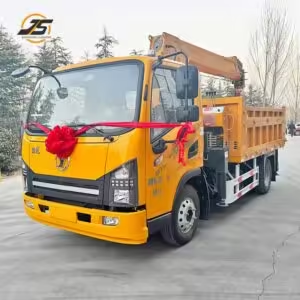
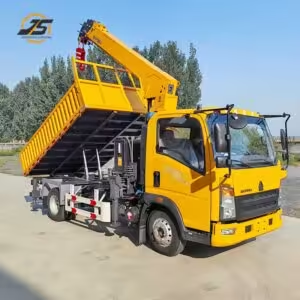
For buyers who need both lifting and transport, a truck mounted knuckle boom crane is especially useful because it combines road mobility, cargo handling, and lifting capability in one machine.
Why Knuckle Boom Cranes Are Popular in Modern Lifting Work
Modern jobsites are becoming more space-limited and task-specific. Many projects do not simply need a crane that can lift high. They need a crane that can lift accurately, work close to structures, move between sites, and handle different material types.
A knuckle boom crane answers these needs because it offers:
- Compact folding storage
- Flexible boom movement
- Good maneuverability in restricted spaces
- Accurate load placement
- Efficient loading and unloading
- Strong compatibility with truck-mounted applications
- Useful reach around barriers and obstacles
- Better space utilization on the vehicle
This makes it a strong choice for companies that handle repeated lifting tasks in different locations. Instead of using separate lifting and transport machines, buyers can use one crane truck to load, carry, and unload materials.
For buyers comparing different equipment types, the full product page can help separate knuckle boom cranes from truck cranes, spider cranes, and aerial work platforms.
Knuckle Boom Crane vs. Straight Boom Crane
A knuckle boom crane and a straight boom crane can both lift materials, but they are designed for different working needs.
A straight boom crane is often selected when the work requires height, direct reach, and vertical lifting. A knuckle boom crane is often preferred when the work requires flexible positioning, compact storage, and movement around obstacles.
| Comparison Point | Knuckle Boom Crane | Straight Boom Crane |
|---|---|---|
| Boom structure | Articulated folding boom | Straight or telescopic boom |
| Main advantage | Flexibility and compact folding | Height and direct reach |
| Best working area | Tight, complex, or obstructed sites | Open areas with vertical lifting needs |
| Storage style | Folds into a compact position | Requires longer boom storage space |
| Load placement | Good for precise positioning | Good for direct lifting |
| Common use | Loading, unloading, delivery, utility work | Construction lifting, general hoisting |
| Vehicle space use | More compact when folded | May occupy more length |
A straight boom crane is often better when height is the priority. A knuckle boom crane is often better when material must be placed carefully in areas with limited access.
For buyers who need direct lifting and transport, a truck crane may be suitable. For buyers who need compact folding movement, a knuckle boom crane is usually more practical.
Best Applications for a Knuckle Boom Crane
A knuckle boom crane can be used in many industries because of its flexible boom movement and truck-mounted compatibility.
Construction Material Handling
Construction sites often need to unload steel, pipes, panels, formwork, timber, tools, and prefabricated parts. A knuckle boom crane can lift materials from the truck bed and place them closer to the working area, even when the site is crowded.
Urban Delivery and Loading
In cities, loading zones are often narrow. A compact folding boom helps reduce working space requirements and supports safer placement in streets, courtyards, and restricted delivery areas.
Municipal Maintenance
Municipal teams may need to lift lighting poles, traffic equipment, road parts, drainage components, signs, and maintenance tools. A knuckle boom crane truck can move quickly between work points and handle varied lifting tasks.
Utility and Power Line Work
Utility projects often require lifting in areas with poles, cables, roadside barriers, or uneven ground. The articulated boom structure helps operators place tools and materials more accurately.
Landscaping and Outdoor Projects
Large stones, trees, garden structures, fencing materials, and outdoor equipment can be difficult to handle manually. A knuckle boom crane helps reduce labor intensity and improve placement accuracy.
Logistics Yards and Warehouses
In loading yards, a knuckle boom crane can support repeated loading and unloading of machinery, equipment, packaged materials, and industrial goods.
Shipyards and Docks
Dockside work often involves heavy materials, irregular loads, and limited working space. The folding boom design can support flexible material handling in these environments.
Why Compact Folding Design Matters

One of the biggest advantages of a knuckle boom crane is its folding design. When not in use, the boom can fold into a compact position, reducing the space occupied on the vehicle.
This matters for several reasons:
- More usable truck bed space
- Easier road travel
- Better maneuverability in narrow areas
- Reduced transport interference
- Faster preparation for repeated lifting tasks
- More practical storage when parked
For companies that use a crane truck every day, this compact structure can improve workflow. The vehicle can arrive at a site, deploy the crane, complete loading or unloading, fold the boom, and move to the next job with less setup difficulty.
This is one reason knuckle boom cranes are commonly used in delivery, construction support, municipal service, and material handling work.
How to Choose the Right Capacity
Choosing a knuckle boom crane should not be based only on maximum lifting capacity. Like other cranes, lifting ability changes according to working radius, boom angle, extension length, outrigger setup, and load condition.
Buyers should first define:
- Typical load weight
- Maximum load weight
- Required lifting radius
- Required lifting height
- Load size and shape
- Lifting frequency
- Jobsite access conditions
- Whether the crane must also transport materials
A crane that can lift a heavy load close to the truck may not lift the same load at full extension. This is why buyers should always review the load chart and operating conditions before choosing a model.
| Buyer Question | Why It Matters |
| What is the typical load weight? | Helps choose a practical capacity range |
| What is the maximum load weight? | Helps prevent undersizing |
| How far must the load be placed? | Determines required working radius |
| How high must the load be lifted? | Affects boom length selection |
| Is the load compact or irregular? | Influences rigging and placement |
| How often will the crane lift daily? | Affects hydraulic and durability needs |
| Is the site narrow or open? | Affects boom type and vehicle size |
A well-matched knuckle boom crane should handle common lifting tasks smoothly without being overbuilt or underpowered.
Working Radius and Load Chart: The Key to Safe Selection
For any knuckle boom crane, the load chart is essential. It shows how much the crane can lift under specific working conditions.
Buyers should remember that lifting capacity is not fixed. It changes depending on:
- Boom extension
- Boom angle
- Horizontal distance from the crane
- Lifting direction
- Outrigger deployment
- Ground condition
- Load shape
- Hook and attachment configuration
The farther the load is from the crane center, the more important stability and rated capacity become. This is why a crane should be selected based on the real working radius, not only the maximum lifting number.
For example, a buyer who frequently unloads materials near the truck may need a different configuration from a buyer who needs to place materials across a wall, fence, trench, or platform.
The OSHA cranes and derricks in construction page is a useful external reference for understanding why rated capacity, setup, and site safety are important in lifting operations.
Hydraulic System Performance
A knuckle boom crane relies heavily on hydraulic movement. The folding arm, extension sections, slewing system, and outriggers all depend on hydraulic power.
A good hydraulic system should provide:
- Smooth boom movement
- Stable lifting response
- Controlled folding and extension
- Reliable outrigger operation
- Good heat management
- Strong sealing performance
- Easy maintenance access
- Accurate operator control
Hydraulic control is especially important when placing loads in narrow or crowded areas. A crane that moves too suddenly can be difficult to control. A crane that responds smoothly helps improve accuracy and safety.
For repeated daily work, hydraulic durability matters as much as lifting strength. Buyers should ask about hydraulic pressure, oil flow, cylinder quality, hose layout, and maintenance requirements before choosing a model.
Outriggers and Stability
Outriggers are critical for safe crane operation. They extend the support base and help stabilize the crane during lifting.
For a knuckle boom crane truck, buyers should check:
- Outrigger span
- Front and rear outrigger configuration
- Ground contact area
- Hydraulic outrigger control
- Stability during side lifting
- Setup convenience
- Compatibility with jobsite conditions
Ground condition is just as important as crane structure. Soft soil, loose gravel, slopes, weak pavement, and underground voids can all affect stability. The operator should confirm ground support before every lift.
A knuckle boom crane is often used in tight areas, but compact operation does not remove the need for proper setup. Even a flexible crane must be positioned safely and supported correctly.
Truck-Mounted Knuckle Boom Crane: Why the Chassis Matters

When a knuckle boom crane is mounted on a truck, the chassis becomes part of the lifting solution. It affects driving, stability, payload, access, turning radius, and long-term durability.
Important chassis factors include:
- Wheelbase
- Engine power
- Frame strength
- Braking performance
- Tire specification
- Cargo body size
- Payload requirement
- Road condition adaptability
- Maintenance convenience
A small urban delivery crane may require a compact chassis for narrow streets. A construction or utility crane may need stronger frame support and better stability. A logistics crane may need more cargo space and efficient loading access.
The crane and chassis should be matched as one system. A strong crane on an unsuitable chassis can create performance and stability problems. A good supplier should evaluate the lifting task, transport requirement, and road condition together.
Attachments and Work Flexibility
One reason buyers choose a knuckle boom crane is its adaptability. Depending on configuration, it may support different lifting tools or attachments for various materials.
Common work needs may include:
- Hook lifting
- Palletized material handling
- Pipe handling
- Equipment loading
- Containerized cargo movement
- Timber or pole handling
- Construction component placement
The right attachment depends on the load type. Buyers should not only ask whether the crane can lift the load. They should ask how the load will be connected, balanced, controlled, and released.
Safe rigging and attachment selection are important for avoiding load swing, material damage, and unstable lifting.
Safety Standards and Operator Planning
A knuckle boom crane must be selected and operated with safety in mind. Buyers should consider equipment safety, operator training, inspection, and working procedures before putting the machine into service.
Important safety planning includes:
- Load chart use
- Pre-operation inspection
- Outrigger setup
- Ground condition checking
- Operator visibility
- Signal communication
- Safe working radius
- Power line awareness
- Wind and weather limits
- Hydraulic system inspection
- Hook and rigging inspection
- Maintenance records
The ASME B30.22 standard for articulating boom cranes is a relevant authority for understanding the safety framework around articulating boom cranes. Buyers working in construction environments may also review OSHA crane safety standards to better understand regulatory expectations.
Safety should not be treated as an after-sales issue. It should influence crane selection, operator training, maintenance planning, and daily use.
Common Buying Mistakes to Avoid
Many buyers make decisions based only on lifting capacity or general product appearance. This can lead to equipment that does not match real working conditions.
Avoid these common mistakes:
Choosing Only by Maximum Capacity
Maximum capacity does not represent performance at every boom position. Always check the load chart.
Ignoring Working Radius
A crane must lift the required load at the required distance. Radius matters as much as weight.
Overlooking Chassis Matching
The chassis must support both driving and lifting conditions.
Forgetting Jobsite Space
A knuckle boom crane is compact, but it still needs safe outrigger space and working clearance.
Not Planning Maintenance
Hydraulic systems, pins, joints, hoses, and structural parts need regular inspection.
Ignoring Operator Training
Flexible equipment requires skilled operation. Training improves safety and efficiency.
Selecting Without Load Details
The supplier needs information about load weight, shape, radius, height, and working frequency.
Knuckle Boom Crane Selection Checklist
Before asking for a quotation or model recommendation, buyers should prepare a clear working profile.
| Selection Item | What to Confirm |
| Main application | Construction, logistics, utility, municipal, dock, yard |
| Typical load | Steel, pipes, panels, machinery, tools, poles, cargo |
| Load weight | Typical and maximum lifting weight |
| Working radius | Distance from crane center to load placement point |
| Lifting height | Required vertical lifting range |
| Site condition | Narrow street, factory, yard, construction site, soft ground |
| Chassis need | Road travel, payload, cargo bed size, turning radius |
| Operation frequency | Occasional, daily, repeated heavy use |
| Safety requirement | Local rules, operator training, inspection needs |
| Customization | Boom, chassis, outriggers, control system, cargo body |
With this information, the supplier can recommend a more suitable crane rather than only matching a general capacity number.
For project-specific recommendations, buyers can submit load details and working conditions through the contact page.
When a Knuckle Boom Crane Is the Right Choice
A knuckle boom crane is a strong choice when the work requires flexibility, compact storage, and accurate placement.
It is especially suitable when:
- The jobsite is narrow or crowded.
- Loads must be placed around obstacles.
- The crane needs to fold compactly during transport.
- The vehicle must carry materials after lifting.
- The project requires repeated loading and unloading.
- The work involves multiple locations in one day.
- The operator needs controlled material placement.
- The buyer wants one machine for lifting and transport.
It may not be the best choice if the project requires long-duration suspended loads at high elevation or extreme lifting capacity at long radius. In those cases, buyers should compare other crane types based on working conditions.
Maintenance Tips for Long-Term Reliability
A knuckle boom crane has many moving joints, hydraulic cylinders, pins, hoses, and structural parts. Regular maintenance is important for safe and reliable operation.
Maintenance should include:
- Checking hydraulic oil level and quality
- Inspecting hoses and fittings
- Lubricating pins and joints
- Checking boom sections for wear or damage
- Testing outrigger operation
- Inspecting hook and lifting accessories
- Checking slewing system movement
- Reviewing control response
- Tightening fasteners
- Inspecting chassis condition
- Recording service history
Daily inspection helps identify small issues before they become serious problems. For companies using the crane frequently, a maintenance schedule should be part of normal operation.
Why the Right Knuckle Boom Crane Improves Work Efficiency

The right knuckle boom crane can improve work efficiency in several ways.
It can reduce manual handling, improve material placement, support faster loading and unloading, and help teams complete more jobs with one machine. Because it folds compactly, it also helps preserve vehicle space and makes movement between sites easier.
For B2B buyers, the real value is not only in lifting. It is in workflow improvement:
- Faster jobsite setup
- Better use of truck space
- Fewer support machines needed
- More flexible material placement
- Better access in restricted areas
- Improved loading efficiency
- Stronger adaptability across industries
A well-selected knuckle boom crane can become a daily productivity tool for construction, logistics, utilities, municipal maintenance, and industrial material handling.
Conclusion
A knuckle boom crane is a highly practical lifting solution for buyers who need compact structure, flexible movement, and precise load placement. Its articulated folding boom makes it especially valuable in narrow, crowded, or obstacle-heavy work areas where straight boom equipment may not be efficient.
When choosing a knuckle boom crane, buyers should evaluate more than lifting capacity. Important factors include working radius, load chart, boom structure, hydraulic performance, chassis matching, outrigger stability, attachments, safety requirements, and long-term maintenance support.
For buyers who need a flexible truck-mounted lifting solution, the knuckle boom crane product category is a useful place to compare available options. For customized lifting needs, chassis requirements, or application-specific recommendations, submit your project details through the contact page.
 English
  Russian
  French
  Spanish
  Arabic