

In modern material handling and logistics operations, versatility and efficiency are key factors in equipment selection. A forklift tail crane—also known as a forklift-mounted jib crane or forklift tail lift—is an attachment that integrates a lifting boom onto the rear of a standard forklift. It combines the forklift’s mobility with crane-like hoisting capability, enabling both pallet handling and suspended load lifting.
How It Works
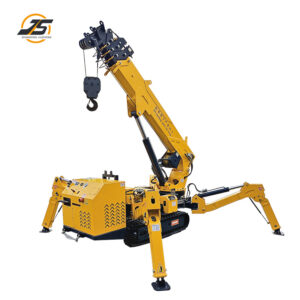
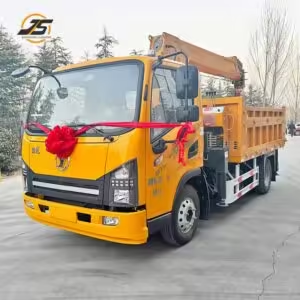
A forklift tail crane typically consists of the forklift chassis (which provides mobility and control), a telescopic or articulating boom arm, and a lifting mechanism with a hook assembly. The crane assembly is mounted on the rear platform or tail section of the forklift. The boom arm can be extended, retracted, and often rotated, allowing the operator to lift and move suspended loads to positions that would be difficult for a standard forklift alone.
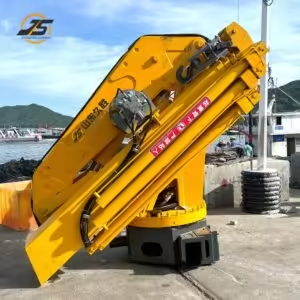
Many models feature a full knuckle-boom (articulating) design that folds compactly when not in use, while others use a telescopic straight boom for maximum reach. Modern units incorporate hydraulic systems powered by the forklift’s existing hydraulic system, enabling smooth and precise control. The assembly can be permanently installed or designed to be detachable.
Key Advantages
Cost-effectiveness: Instead of purchasing dedicated cranes or hoists, businesses can add a jib attachment to an existing forklift. The initial investment is substantially lower than that of a standalone mobile crane or overhead crane system.
Enhanced mobility: Unlike conventional truck-mounted cranes with larger turning radii, a forklift tail crane retains the compact size and agile handling of the forklift. It can pass through most factory and warehouse doorways, operate in low-clearance spaces, and navigate narrow aisles.
360-degree rotational capability: Many models are equipped with a full 360-degree slewing mechanism, allowing the operator to rotate the boom in any direction without repositioning the entire vehicle. This expands the working envelope and reduces the need for frequent repositioning.
Space efficiency: With a telescopic boom that can extend to significant lengths, forklift tail cranes can access hard-to-reach areas that would otherwise require scaffolding, ladders, or manual rigging.
Single-operator functionality: Most systems can be operated entirely by one person, either through the forklift’s existing controls or via wireless remote control.
Design Variations
There are several design variations of forklift tail cranes. Some models are lightweight units with rated lifting capacities starting from 3.5 tons, while heavy-duty telescopic models can handle loads up to 50 tons or more. The choice depends on the specific lifting requirements and operating environment.
Safety Considerations
Proper operator training, regular inspection, and adherence to load capacity ratings remain essential for safe and effective use of these versatile tools. Operators should never exceed the rated capacity of the tail crane and should ensure loads are properly secured before lifting.
 English
  Russian
  French
  Spanish
  Arabic