

Table of Contents
A Practical, Real-World Guide for Buyers, Operators, and Project Planners
When you are planning lifting operations in confined or complex environments, choosing the right crane is no longer just about lifting capacity. It is about precision, adaptability, safety, and long-term operating efficiency. This is exactly where a small knuckle boom crane becomes a strategic advantage rather than just another piece of equipment.
If you are managing construction projects, logistics operations, municipal services, or industrial maintenance tasks, you have likely noticed a shift in how lifting work is approached. Jobsites are tighter. Regulations are stricter. Skilled operators are harder to find. You need equipment that works with you—not against you.
In this guide, you will explore how small knuckle boom cranes solve modern lifting challenges, how they compare to other crane types, and how you can apply them in real-world scenarios to improve productivity, reduce risk, and control costs.
Understanding What a Small Knuckle Boom Crane Really Is

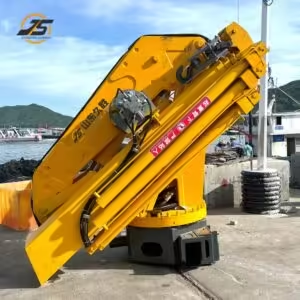
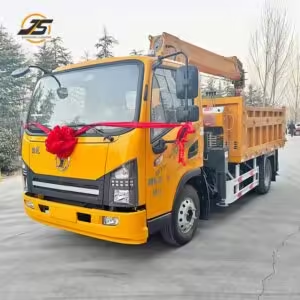
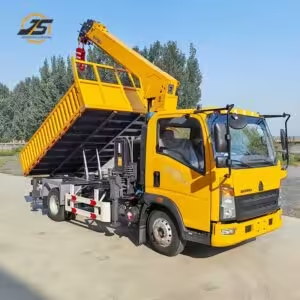
A small knuckle boom crane is a compact articulated crane mounted on a truck chassis, trailer, or fixed platform. Unlike straight boom cranes, it uses folding hydraulic joints, allowing the boom to bend and extend around obstacles with high precision.
What makes it “small” is not weakness—but optimized scale. You are looking at equipment designed to handle moderate loads in restricted spaces without sacrificing control or reach.
Key Characteristics You Should Know
| Feature | Practical Benefit for You |
|---|---|
| Articulated (knuckle) boom | You can lift over, under, and around obstacles |
| Compact folded size | Easier transport and parking in urban areas |
| Hydraulic precision | Greater load control for sensitive materials |
| Versatile mounting options | Works on trucks, trailers, or fixed bases |
| Faster setup time | Less downtime between tasks |
If you often operate in urban construction zones, factory yards, or narrow access sites, these features translate directly into real savings.
Why Small Knuckle Boom Cranes Are Gaining Popularity Worldwide

You may be wondering why demand for small knuckle boom cranes is growing faster than many traditional lifting solutions. The answer lies in changing work environments and economic pressure.
According to general trends documented in global construction and logistics reports (see background information on articulated cranes via
Wikipedia’s overview of knuckle boom cranes), compact articulated cranes are increasingly favored due to space efficiency and operational flexibility.
Major Drivers Behind the Trend
- Urbanization
- Cities are denser than ever.
- You need lifting equipment that works without blocking roads or sidewalks.
- Labor Efficiency
- Skilled crane operators are costly.
- Modern knuckle boom cranes allow faster learning curves.
- Safety Regulations
- Better load control reduces accident risk.
- Improved stability helps meet workplace safety standards (see guidance from
OSHA crane safety resources).
- Multi-Function Projects
- One crane often needs to handle installation, transport, and positioning tasks.
- A small knuckle boom crane can replace multiple machines.
Real-World Case Study: Urban Equipment Installation
Imagine you are responsible for installing HVAC units on rooftops in a crowded city center.
The Challenge You Face
- Limited street access
- Strict noise and traffic control regulations
- Narrow rooftop access points
- Sensitive equipment that cannot swing freely
How a Small Knuckle Boom Crane Solves It
You position the truck in a legal parking zone. The crane unfolds upward rather than outward. Using the articulated joints, you guide the load over a parapet wall and gently lower it into place.
Because the crane allows fine-movement control, you reduce the need for additional rigging personnel on the roof. The job finishes faster, safer, and without penalties for street obstruction.
This is not theory—it is how many urban contractors are now operating successfully.
Comparing Small Knuckle Boom Cranes with Other Crane Types
To make a confident purchasing decision, you need clarity. The table below compares small knuckle boom cranes with other commonly used lifting equipment.
| Crane Type | Space Efficiency | Precision | Setup Time | Ideal Use Case |
|---|---|---|---|---|
| Small knuckle boom crane | High | Very high | Short | Urban, industrial, logistics |
| Straight boom truck crane | Medium | Medium | Medium | Open construction sites |
| Mobile telescopic crane | Low | Medium | Long | Heavy lifts, wide areas |
| Forklift with jib | High | Low | Short | Light material handling |
If your projects demand controlled lifting in constrained environments, the small knuckle boom crane consistently stands out.
How You Can Use a Small Knuckle Boom Crane Across Industries
Construction and Renovation
You can lift steel beams, windows, prefabricated components, and tools directly to upper floors without scaffolding repositioning.
Logistics and Delivery
You unload heavy pallets, containers, or machinery without additional lifting equipment, improving turnaround time.
Utilities and Municipal Services
You handle streetlight installation, utility box placement, and signage maintenance efficiently—often without road closures.
Manufacturing and Maintenance
Inside industrial zones, you move machines into tight production spaces with minimal disruption.
For industry-wide applications and safety considerations, you can reference general lifting guidance from
International Labour Organization resources.
What You Should Look for When Choosing the Right Model

Before purchasing, you should evaluate the crane based on how you actually work, not just brochure numbers.
Key Selection Factors
- Maximum lifting moment (not just max load)
- Working radius at partial extension
- Hydraulic stability system
- Ease of maintenance
- Availability of spare parts
You can also compare crane specifications using general engineering references such as
Engineering Toolbox – lifting calculations.
Maintenance and Long-Term Cost Control
A small knuckle boom crane is an investment. To protect it, you need consistent maintenance routines.
Practical Maintenance Checklist
| Task | Recommended Frequency |
|---|---|
| Hydraulic hose inspection | Weekly |
| Bolt and joint torque check | Monthly |
| Lubrication of articulation points | Every 250 hours |
| Structural inspection | Annually |
Following structured maintenance practices—aligned with general machinery guidelines such as those outlined by
ISO mechanical safety standards—helps extend service life and prevent downtime.
Safety: How You Reduce Risk on Every Lift
You play a critical role in crane safety. A small knuckle boom crane gives you better control, but only if used correctly.
Key Safety Advantages You Gain
- Reduced swing radius
- Improved load visibility
- Stable articulated positioning
You should still ensure:
- Operators are properly trained
- Loads are correctly rated
- Ground conditions are assessed
For additional safety education, many professionals consult
NIOSH workplace safety resources.
The ROI You Can Expect

When you invest in a small knuckle boom crane, the return is not just financial—it is operational.
Tangible Returns
- Fewer rental costs
- Faster project completion
- Reduced labor requirements
Intangible Returns
- Improved client satisfaction
- Enhanced jobsite reputation
- Lower accident risk
Over time, these benefits often outweigh the initial purchase cost.
Final Thoughts: Why This Crane Fits the Future of Lifting
If you are looking to future-proof your operations, a small knuckle boom crane gives you flexibility that traditional equipment cannot match. You gain control, efficiency, and adaptability—qualities that matter more each year as jobsite demands evolve.
By understanding how to select, operate, and maintain this type of crane, you position yourself to handle modern lifting challenges with confidence.
If your goal is to work smarter rather than harder, the small knuckle boom crane is no longer optional—it is essential.
FAQ
Is a small knuckle boom crane suitable for heavy construction?
Yes, as long as your lifts fall within the rated capacity and working radius. It excels in precision-focused tasks.
Can you operate it with one person?
In many cases, yes. However, complex lifts may still require a signal person for safety.
How does it perform in cold or hot climates?
With proper hydraulic oil selection and maintenance, performance remains stable across temperature ranges.
Is operator training mandatory?
While regulations vary by region, proper training is strongly recommended for safety and efficiency.
How long does a typical crane last?
With correct maintenance, service life often exceeds 10–15 years.
 English
  Russian
  French
  Spanish
  Arabic