

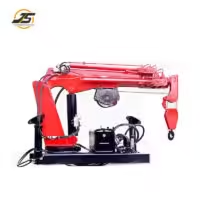
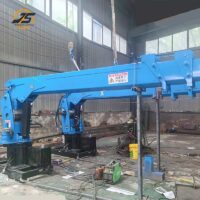
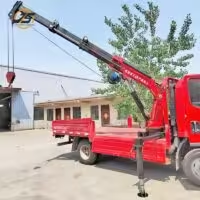
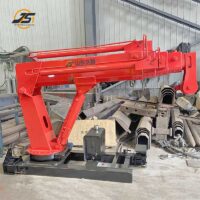
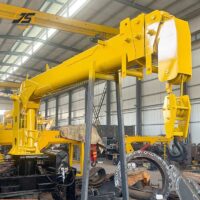
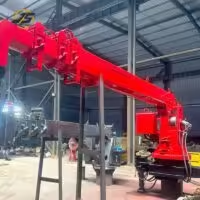
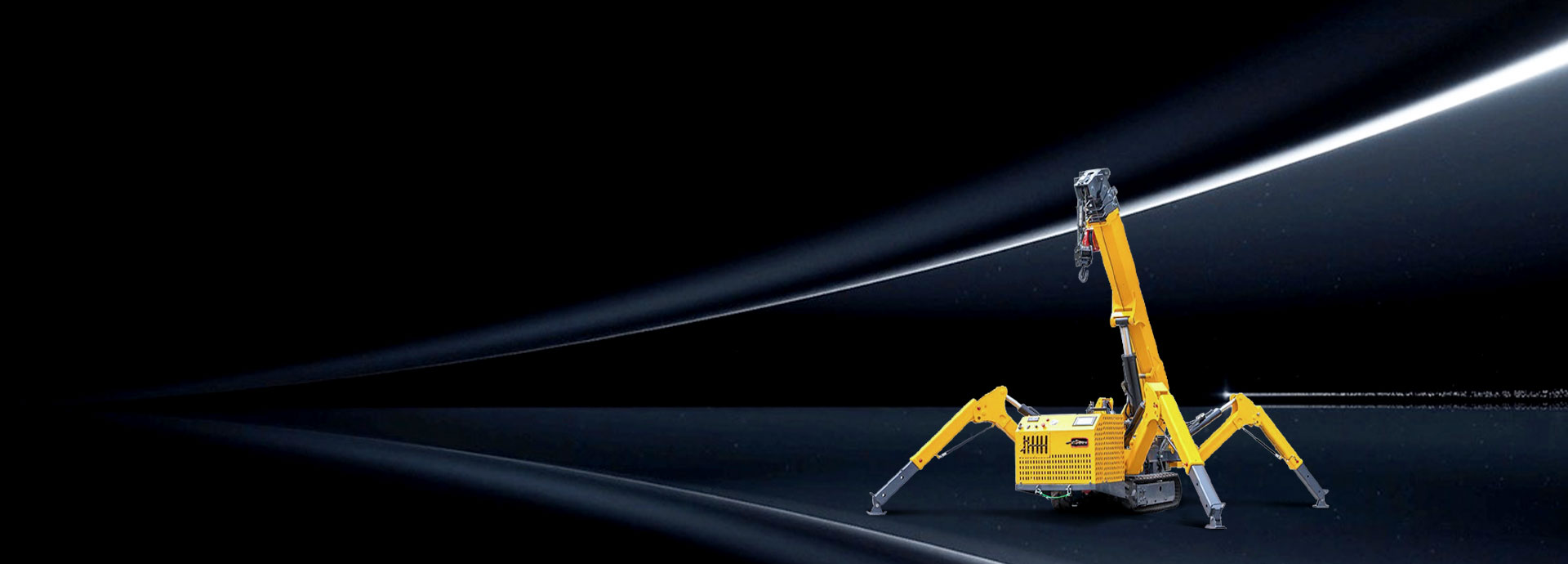
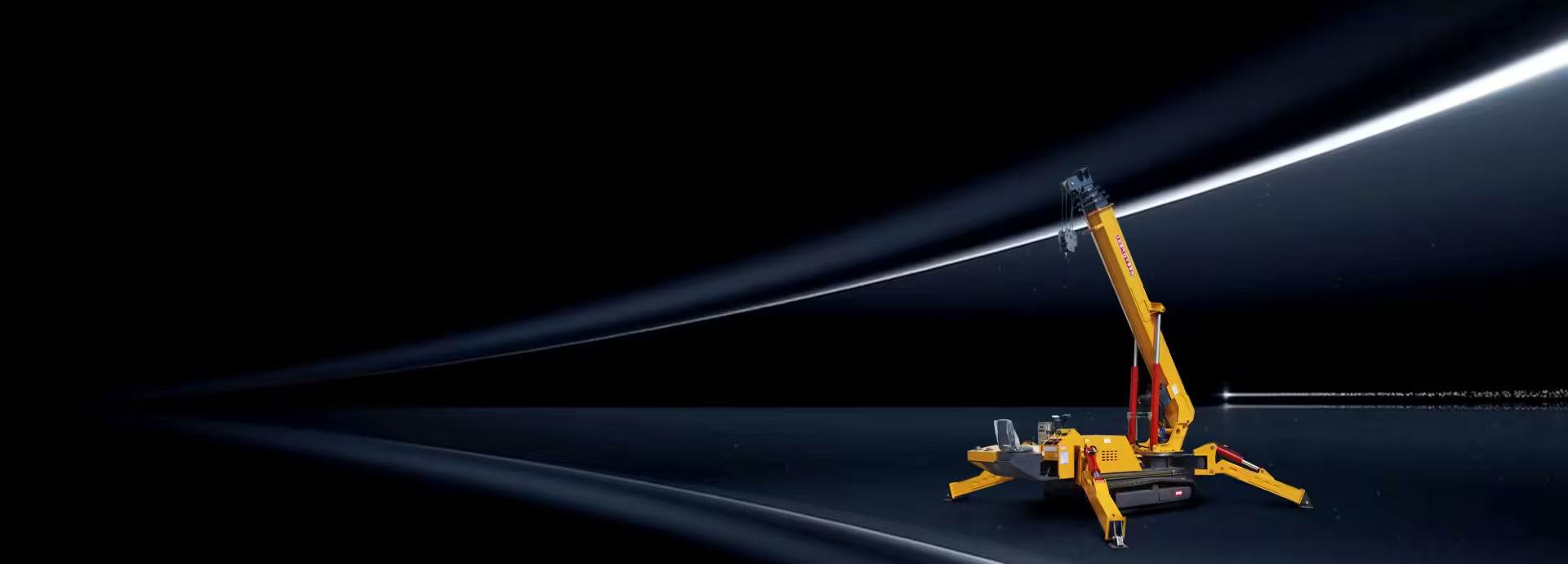
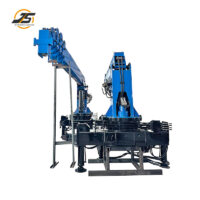
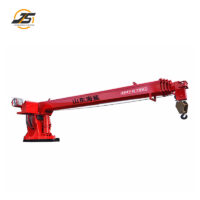
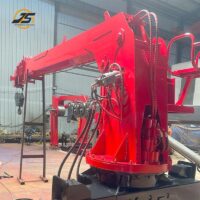
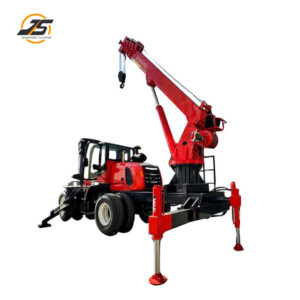
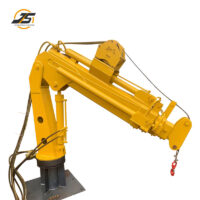
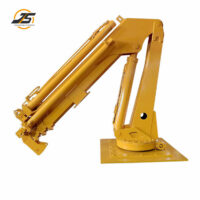
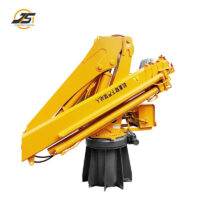
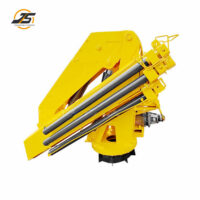
14T winch, 1200m thickened rotary plate, 5m 5-section single-board inner rope arm, double two-stage planetary reducer, 360° continuous rotation (center joint), vertical luffing cylinder, upper operation, the first two double-section frame hydraulic legs, the last two single-section support services

Contact Details
Telephone
+86 153 7656 0472
Address
Beinantian Village South Head, Changgou Town, Jining, Shandong, China
-
 ×
×

14T Boom
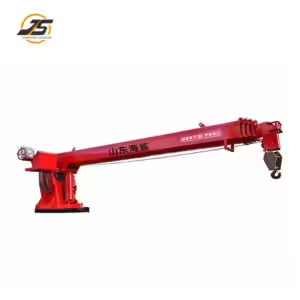
The boom is the core component of lifting equipment (such as truck cranes, crawler cranes, marine cranes, knuckle boom cranes, etc.), enabling cargo lifting and positioning through telescoping, slewing, or folding. Its design directly affects the crane’s lifting capacity, working radius, and applicable scenarios.
Basic Components:
Main Boom: The foundational support structure, typically designed as a box-type or truss configuration, providing the primary load-bearing capacity.
Jib (Optional): Attached to the top of the main boom to extend the working radius or increase lifting height, suitable for specialized operations (e.g., high-rise building construction).
Telescoping Mechanism: Adjusts boom length via hydraulic or mechanical transmission, with some booms supporting multi-stage synchronous extension.
Connection Joints: Utilize high-strength bolts or pin connections to ensure structural stability.
Open full product page14T Boom
-
×
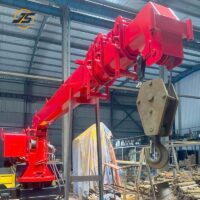
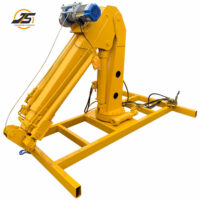
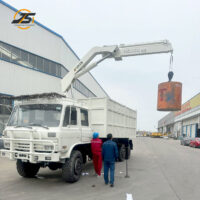
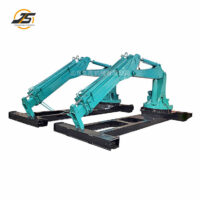
16T Boom
The boom is the core component of lifting equipment (such as truck cranes, crawler cranes, marine cranes, knuckle boom cranes, etc.), enabling cargo lifting and positioning through telescoping, slewing, or folding. Its design directly affects the crane’s lifting capacity, working radius, and applicable scenarios.
Basic Components:
Main Boom: The foundational support structure, typically designed as a box-type or truss configuration, providing the primary load-bearing capacity.
Jib (Optional): Attached to the top of the main boom to extend the working radius or increase lifting height, suitable for specialized operations (e.g., high-rise building construction).
Telescoping Mechanism: Adjusts boom length via hydraulic or mechanical transmission, with some booms supporting multi-stage synchronous extension.
Connection Joints: Utilize high-strength bolts or pin connections to ensure structural stability.
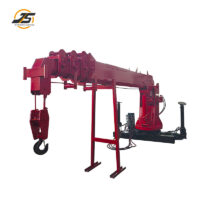
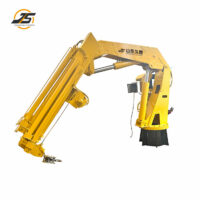
Open full product page14T winch, 1200m thickened rotary plate, 5m 5-section single-board inner rope arm, double two-stage planetary reducer, 360° continuous rotation (center joint), vertical luffing cylinder, upper operation, the first two double-section frame hydraulic legs, the last two single-section support 16T winch, 1200m double-disc ball turntable, 5.5m 5-section single-board inner rope arm, double two-stage planetary reducer, 360″ continuous rotation (center joint), vertical luffing cylinder, upper operation, the first two double-section frame hydraulic legs, The last two single-section legs …
16T Boom
-
×
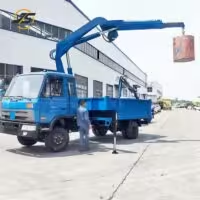
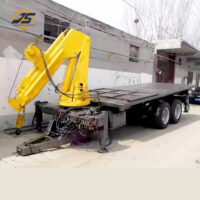
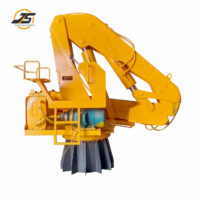
20T Boom
The boom is the core component of lifting equipment (such as truck cranes, crawler cranes, marine cranes, knuckle boom cranes, etc.), enabling cargo lifting and positioning through telescoping, slewing, or folding. Its design directly affects the crane’s lifting capacity, working radius, and applicable scenarios.
Basic Components:
Main Boom: The foundational support structure, typically designed as a box-type or truss configuration, providing the primary load-bearing capacity.
Jib (Optional): Attached to the top of the main boom to extend the working radius or increase lifting height, suitable for specialized operations (e.g., high-rise building construction).
Telescoping Mechanism: Adjusts boom length via hydraulic or mechanical transmission, with some booms supporting multi-stage synchronous extension.
Connection Joints: Utilize high-strength bolts or pin connections to ensure structural stability.
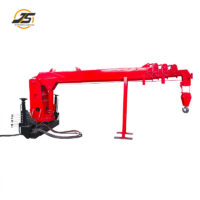
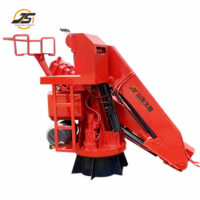
Open full product page20T winch, 1400m】Double row ball rotary plate, 6m 5 sections of single plate inner rope, double one-stage planetary reducer, 360″ continuous rotation (center joint), double vertical fixed luffing cylinder, upper operation, the first two double-section frame hydraulic legs, the last two single-section legs
20T Boom
-
×
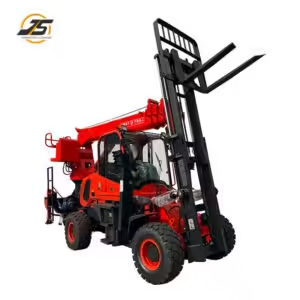
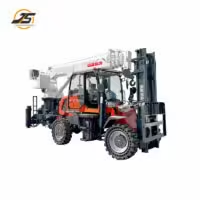
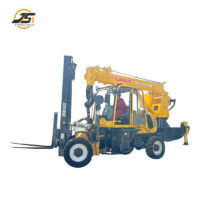
T80 Rough Terrain Forklift Tail Crane
Rough Terrain Forklift Tail Crane
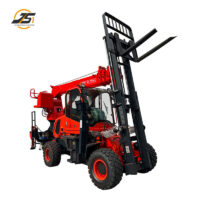
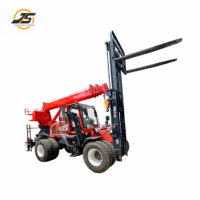
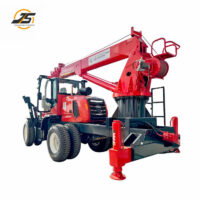
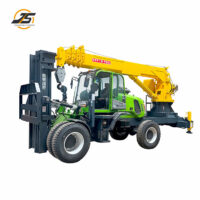
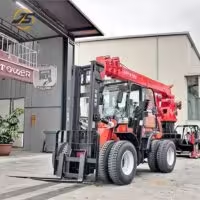
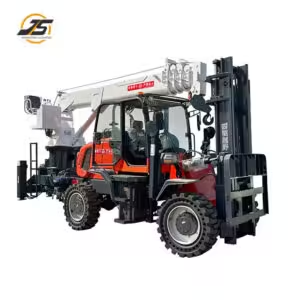
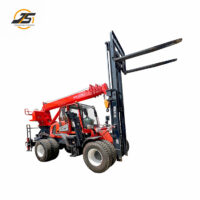
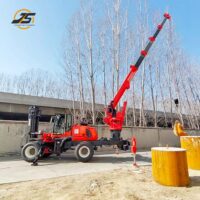
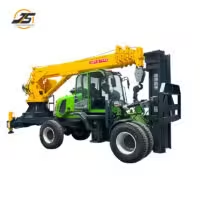
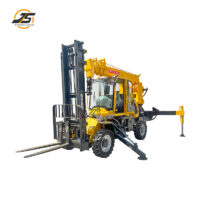
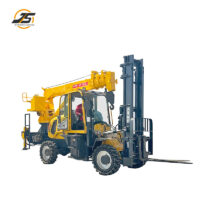
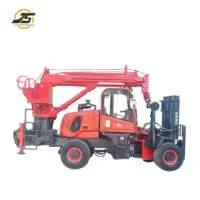
A rough terrain forklift tail crane is a specialized lifting device that integrates a boom attachment onto a forklift. Below is a detailed introduction to its structural features, working principles, and applications.1. Structural Features
Boom Design: The crane boom is typically telescopic and straight-arm, allowing adjustment for various lifting needs. The boom can swivel at different angles, enabling low-level and high-level material handling.Mounting System: The crane is usually connected to the forklift forks via a sleeve mechanism, utilizing the forklift’s existing hydraulic system with quick-release couplings for easy installation and removal.
Space Efficiency: The boom can be folded downward when not in use, minimizing space occupation and allowing the forklift to maneuver, turn, and operate even in tight spaces.
2. Working Principle
Hydraulic Drive: The crane operates via a hydraulic transmission system, where the forklift’s hydraulic pump supplies power. Control valves regulate oil flow to drive hydraulic cylinders, enabling boom extension, retraction, lifting, and lowering.Ease of Operation: The rough terrain forklift tail crane is user-friendly, safe, reliable, and highly mobile, offering high efficiency and versatility.
3. Applications
Confined Space Operations: Due to its compact size and agility, the rough terrain forklift tail crane is ideal for lifting tasks in narrow spaces inaccessible to traditional cranes, such as alleys, low-ceiling workshops, basements, and multi-floor buildings.Aerial Work: With the boom extended and the forklift’s mast raised, it can reach considerable heights (e.g., 13 meters), making it suitable for streetlight installation, billboard mounting, and AC unit placement.
Warehousing & Logistics: The crane can handle bulk bag unloading, doorway installations, and other material-handling tasks.
Landscaping: It efficiently transports saplings and trees for landscaping projects.
Roadside Rescue & Construction: The forklift crane is also used in emergency recovery and small-scale construction sites.
Open full product pageT80 Rough Terrain Forklift Tail Crane Technical Parameters Parameter Value Engine Brand Yuchai 4105 Pressurized Wattage 85 kW Rated lifting weight 8 T Tyre properties Front and rear tires Axle GS3000 heavy cast steel bridge Transmission 280 double high and low speed hydraulic torque converter Tires 12R22.5 vacuum wire tire Standard lifting height 4 m Width of gantry channel 22 cm Outline dimensions 4500*2200*2800 mm (Door frame and cab are removable) Self-weight 9 T Fork length 1.52 m Drive method Four-wheel drive Can be retrofitted 6 m three-stage gantry (optional) Color White, red, blue, yellow, fruit green (customizable) Lifting capacity 8 T Arm length 4 meters, 4 knots, a total elongation of 13 meters T80 Rough Terrain Forklift Tail Crane
-
×
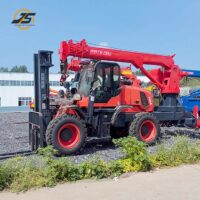
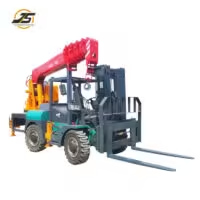
T60 Rough Terrain Forklift Tail Crane
Rough Terrain Forklift Tail Crane
A rough terrain forklift tail crane is a specialized lifting device that integrates a boom attachment onto a forklift. Below is a detailed introduction to its structural features, working principles, and applications.1. Structural Features
Boom Design: The crane boom is typically telescopic and straight-arm, allowing adjustment for various lifting needs. The boom can swivel at different angles, enabling low-level and high-level material handling.Mounting System: The crane is usually connected to the forklift forks via a sleeve mechanism, utilizing the forklift’s existing hydraulic system with quick-release couplings for easy installation and removal.
Space Efficiency: The boom can be folded downward when not in use, minimizing space occupation and allowing the forklift to maneuver, turn, and operate even in tight spaces.
2. Working Principle
Hydraulic Drive: The crane operates via a hydraulic transmission system, where the forklift’s hydraulic pump supplies power. Control valves regulate oil flow to drive hydraulic cylinders, enabling boom extension, retraction, lifting, and lowering.Ease of Operation: The rough terrain forklift tail crane is user-friendly, safe, reliable, and highly mobile, offering high efficiency and versatility.
3. Applications
Confined Space Operations: Due to its compact size and agility, the rough terrain forklift tail crane is ideal for lifting tasks in narrow spaces inaccessible to traditional cranes, such as alleys, low-ceiling workshops, basements, and multi-floor buildings.Aerial Work: With the boom extended and the forklift’s mast raised, it can reach considerable heights (e.g., 13 meters), making it suitable for streetlight installation, billboard mounting, and AC unit placement.
Warehousing & Logistics: The crane can handle bulk bag unloading, doorway installations, and other material-handling tasks.
Landscaping: It efficiently transports saplings and trees for landscaping projects.
Roadside Rescue & Construction: The forklift crane is also used in emergency recovery and small-scale construction sites.
Open full product pageT60 Rough Terrain Forklift Tail Crane Technical Parameters Parameter Value Engine Brand Yuchai 4105 Pressurized Wattage Common Rail 90 kW Rated lifting weight 6 T Cockpit Fully enclosed cab Axle SG30 type axle Transmission 280 Dual high and low speed Tires 12R22.5 Vacuum steel wire Standard lifting height 4 m Width of gantry channel 18 cm (weighted) Outline dimensions 4500*2200*2950 mm Self-weight 5.5 T Fork width 12 cm Fork length 1.52 m Shelf blocking 1.38 m Drive method Four-wheel drive Can be retrofitted 6 m three-stage gantry (optional) Color White, red, blue, yellow, fruit green (customizable) Lifting capacity 6 T Arm length 4 meters, 4 knots, a total elongation of 13 meters T60 Rough Terrain Forklift Tail Crane
-
×
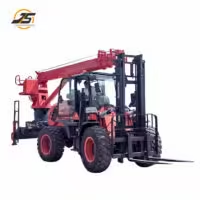
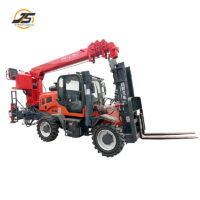
T50 Rough Terrain Forklift Tail Crane
Rough Terrain Forklift Tail Crane
A rough terrain forklift tail crane is a specialized lifting device that integrates a boom attachment onto a forklift. Below is a detailed introduction to its structural features, working principles, and applications.1. Structural Features
Boom Design: The crane boom is typically telescopic and straight-arm, allowing adjustment for various lifting needs. The boom can swivel at different angles, enabling low-level and high-level material handling.Mounting System: The crane is usually connected to the forklift forks via a sleeve mechanism, utilizing the forklift’s existing hydraulic system with quick-release couplings for easy installation and removal.
Space Efficiency: The boom can be folded downward when not in use, minimizing space occupation and allowing the forklift to maneuver, turn, and operate even in tight spaces.
2. Working Principle
Hydraulic Drive: The crane operates via a hydraulic transmission system, where the forklift’s hydraulic pump supplies power. Control valves regulate oil flow to drive hydraulic cylinders, enabling boom extension, retraction, lifting, and lowering.Ease of Operation: The rough terrain forklift tail crane is user-friendly, safe, reliable, and highly mobile, offering high efficiency and versatility.
3. Applications
Confined Space Operations: Due to its compact size and agility, the rough terrain forklift tail crane is ideal for lifting tasks in narrow spaces inaccessible to traditional cranes, such as alleys, low-ceiling workshops, basements, and multi-floor buildings.Aerial Work: With the boom extended and the forklift’s mast raised, it can reach considerable heights (e.g., 13 meters), making it suitable for streetlight installation, billboard mounting, and AC unit placement.
Warehousing & Logistics: The crane can handle bulk bag unloading, doorway installations, and other material-handling tasks.
Landscaping: It efficiently transports saplings and trees for landscaping projects.
Roadside Rescue & Construction: The forklift crane is also used in emergency recovery and small-scale construction sites.
Open full product pageT50 Rough Terrain Forklift Tail Crane Technical Parameters Parameter Value Engine brand Yunnei supercharged 4102 engine Power Common rail 77 kW Rated lifting weight 5 T Cab Fully enclosed cab Axle Large and medium wheel side reduction bridge Transmission case 265 Double high and low speed Tyre 16/70-24 (Longgong tread tire) Standard lifting height 4 m Channel steel width of portal frame 18 cm Overall dimension 4500*2000*2950 mm Weight 5 T Fork width 12 cm Fork length 1.52 m Forklift rack 1.38 m Drive Four-wheel drive Can be added 5 meters three, 6 meters three door frame (optional) 5 meters and 2.7 meters high Color White, red, blue, yellow, green (can be customized) Lifting capacity 5 T Arm length 4 meters, 5 knots, full elongation up to 16 meters T50 Rough Terrain Forklift Tail Crane
-
×
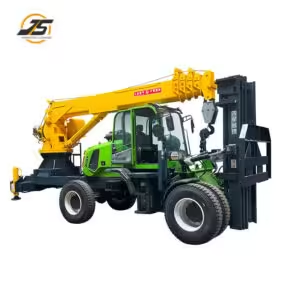
T35 Rough Terrain Forklift Tail Crane
Rough Terrain Forklift Tail Crane
A rough terrain forklift tail crane is a specialized lifting device that integrates a boom attachment onto a forklift. Below is a detailed introduction to its structural features, working principles, and applications.1. Structural Features
Boom Design: The crane boom is typically telescopic and straight-arm, allowing adjustment for various lifting needs. The boom can swivel at different angles, enabling low-level and high-level material handling.Mounting System: The crane is usually connected to the forklift forks via a sleeve mechanism, utilizing the forklift’s existing hydraulic system with quick-release couplings for easy installation and removal.
Space Efficiency: The boom can be folded downward when not in use, minimizing space occupation and allowing the forklift to maneuver, turn, and operate even in tight spaces.
2. Working Principle
Hydraulic Drive: The crane operates via a hydraulic transmission system, where the forklift’s hydraulic pump supplies power. Control valves regulate oil flow to drive hydraulic cylinders, enabling boom extension, retraction, lifting, and lowering.Ease of Operation: The rough terrain forklift tail crane is user-friendly, safe, reliable, and highly mobile, offering high efficiency and versatility.
3. Applications
Confined Space Operations: Due to its compact size and agility, the rough terrain forklift tail crane is ideal for lifting tasks in narrow spaces inaccessible to traditional cranes, such as alleys, low-ceiling workshops, basements, and multi-floor buildings.Aerial Work: With the boom extended and the forklift’s mast raised, it can reach considerable heights (e.g., 13 meters), making it suitable for streetlight installation, billboard mounting, and AC unit placement.
Warehousing & Logistics: The crane can handle bulk bag unloading, doorway installations, and other material-handling tasks.
Landscaping: It efficiently transports saplings and trees for landscaping projects.
Roadside Rescue & Construction: The forklift crane is also used in emergency recovery and small-scale construction sites.
Open full product pageT35 Rough Terrain Forklift Tail Crane Technical Parameters Parameter Value Engine brand Yunnei490VE Power 36.8 kW Rated lifting weight 3.5 T Cab Fully enclosed cab Axle Small wheel side reduction axle Transmission case 265 Double high and low speed Tyre 12-16.5 (chevron tread tire) Standard lifting height 3 m Channel steel width of portal frame 16 cm Overall dimension 4200*1800*2170 mm Weight 3.3 T Fork width 12 cm Fork length 1.2 m Forklift rack 1.15 m Drive Four-wheel drive 4-meter gantry can be added (optional) 2.7 meters high Color White, red, blue, yellow, green (can be customized) Lifting capacity 5 T Arm length 4 meters, 4 knots, a total elongation of 13 meters T35 Rough Terrain Forklift Tail Crane
-
×
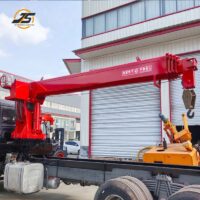
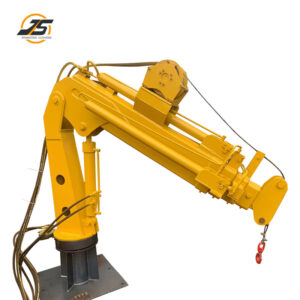
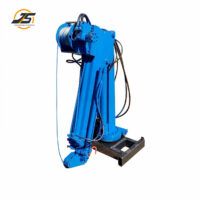
3.2 T Knuckle Boom Crane
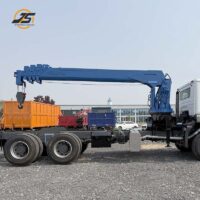
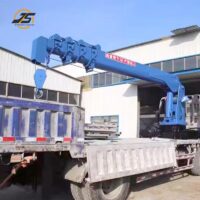
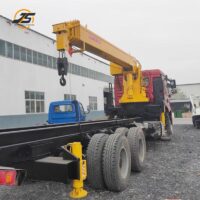
The knuckle boom crane is a kind of lifting equipment, which has the characteristics of flexibility, efficiency, safety and reliability, and can be installed behind the cab of the automobile chassis, which can realize 360° full-range hoisting operations, with large lifting torque and small working space.
Open full product page3.2 T Knuckle Boom Crane Technical Parameters Parameter Value Max. Lifting Moment 6 Ton.M Max. Lifting Capacity 3200kg Max. Working Radius 7.2 m Max. Working Height 9.6 m Slewing Angle 360° Installation Space 900mm Outtrigger Span 1940/4000mm Crane Self Weight ≈1.5T 3.2 T Knuckle Boom Crane
-
×
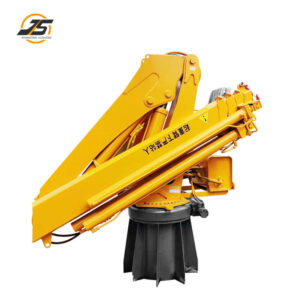
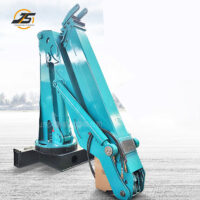
5 T Knuckle Boom Crane
Knuckle boom crane is a kind of lifting equipment with hydraulic drive as the core technology. It is widely used in marine engineering, disaster relief, infrastructure, logistics and transportation, municipal construction and other fields. Its core features and application scenarios are as follows:
1. Core features
Flexible structural design
Flexibility: The arm length can be extended or shortened according to the operation requirements, adapting to narrow spaces or long arm operation scenarios.
Segmented design: It is composed of multiple detachable sections, which is easy to install and transport, and meets the lifting requirements of different occasions.
Mechanical arm design: It has multiple joints, which can achieve multi-directional movement, bypass obstacles and work deep inside the equipment.
Lightweight and intelligent
Lightweight design: Reduce equipment weight, reduce operating intensity, and improve safety.
Intelligent control: Equipped with intelligent control system, supports manual control and suspension operation, automatically identifies unstable factors, and ensures safe and efficient lifting.2. Application scenarios
Marine engineering
It is used for heavy-duty tasks such as offshore wind power installation and oil platform construction to lift wind turbine blades, towers and platform modules.
Disaster Rescue
In the salvage of sunken ships, maintenance of underwater facilities and emergency rescue, lifting salvage equipment, diving bells or distressed materials.
Infrastructure and logistics transportation
Applicable to cargo loading and unloading in ports, workshops, construction sites, municipal construction, railway maintenance and other scenarios.
Special operations
Aerial work platforms, work buckets, clamps and other tools can be added to expand to sanitation, gardening, trenchless and other fields.Open full product page5 T Knuckle Boom Crane Technical Parameters Parameter Value Max. Lifting Moment 10 Ton.M Max. Lifting Capacity 5000kg Max. Working Radius 8.2 m Max. Working Height 10.6 m Slewing Angle 360° Installation Space 800mm Outtrigger Span 2150/4300mm Crane Self Weight ≈1.9T 5 T Knuckle Boom Crane
























Load More
Help Center
Get Answers to Your Questions
At Shandong Jiusheng, we prioritize your experience in customizing your lifting equipment.
How to start customization?
Visit our site, select the product, click “Customize Now”, fill in requirements and submit.
Check design solutions before confirmation?
Yes. Our team provides preliminary designs for your review after you submit basic info.
Info needed for customization?
Working scenarios, performance needs, special designs, and contact details.
Modify confirmed plan?
Early minor changes allowed; contact us promptly for adjustments.
Deposit for customization?
Yes, a deposit (50% of the total cost) is required to get started.
Get a quote before finalizing?
Sure. Submit requirements and our team will provide a detailed quote.
Start a customized solution
Want to build your own lifting equipment?
Get a Quote Right Now
What we offer
Make every customization precise and innovative
Shandong Jiusheng Intelligent Equipment Co., Ltd. is a high-tech enterprise integrating the research and development, production and sales of crane equipment. The company has many product patents, direct supply from the factory, no middlemen, adhering to the concept of green win-win, closely connected with customers, establishing strategic partnerships, constantly improving product performance, and wholeheartedly providing customers with valuable equipment.
R&D Strength
Shandong Jiusheng is a high-tech enterprise with many product patents and a good reputation.
Custom processing
Advanced R&D team supports customized production and accurately adapts to the needs of multiple scenarios.
quality assurance
Carefully selected materials, refined craftsmanship, and multiple certifications to ensure quality.
transportation
Global logistics coverage, accurate delivery to the customer's designated location.
Technical training
Provide video training and operation guidance to solve customer problems remotely.
After-sales guarantee
The product is guaranteed for one year, and the 7*24 hours online customer service responds to your needs.
 English
  Russian
  French
  Spanish
  Arabic